|
Eager Space | Videos by Alpha | Videos by Date | All Video Text | Support | Community | About |
|---|

LDEF framework crater analysis
https://sci-hub.se/https://www.sciencedirect.com/science/article/abs/pii/027311779390571R
Orbital debris database
https://orbitaldebris.jsc.nasa.gov/library/HOOSF_16e.pdf
Zerua orbitalal simulator
https://www.zerua.space/
Welcome to eager space.
What started as a single video has now become a series of 5 - or perhaps 6 - videos.
I apologize for the length; I was unable to make my thoughts coherent in shorter form.
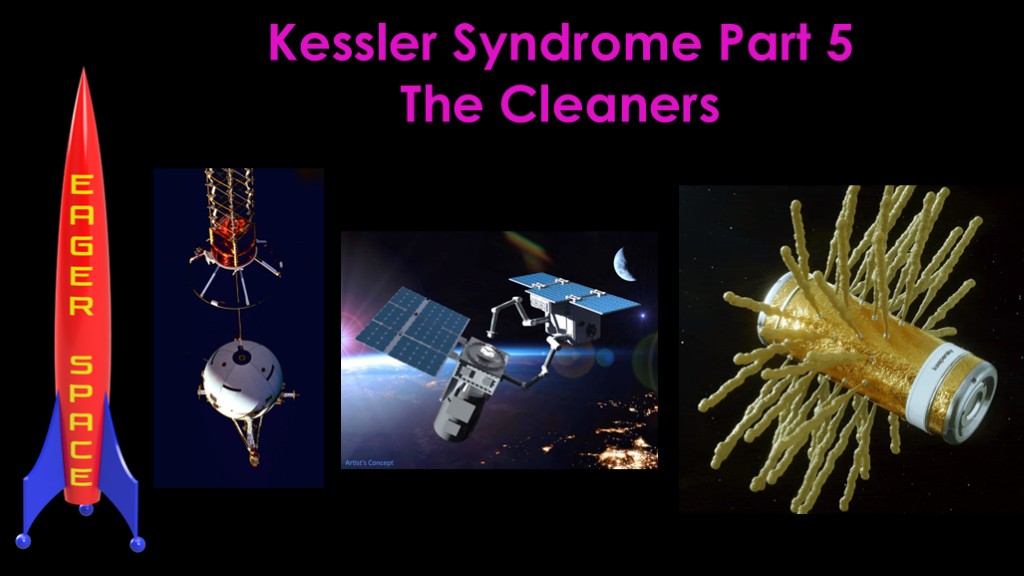
In this video we're going to look at various ways that might be used to get rid of debris that is already in orbit - ways to get it to reenter.
What might that look like?
Let's say that you've developed a space tug and you want to do a test mission...
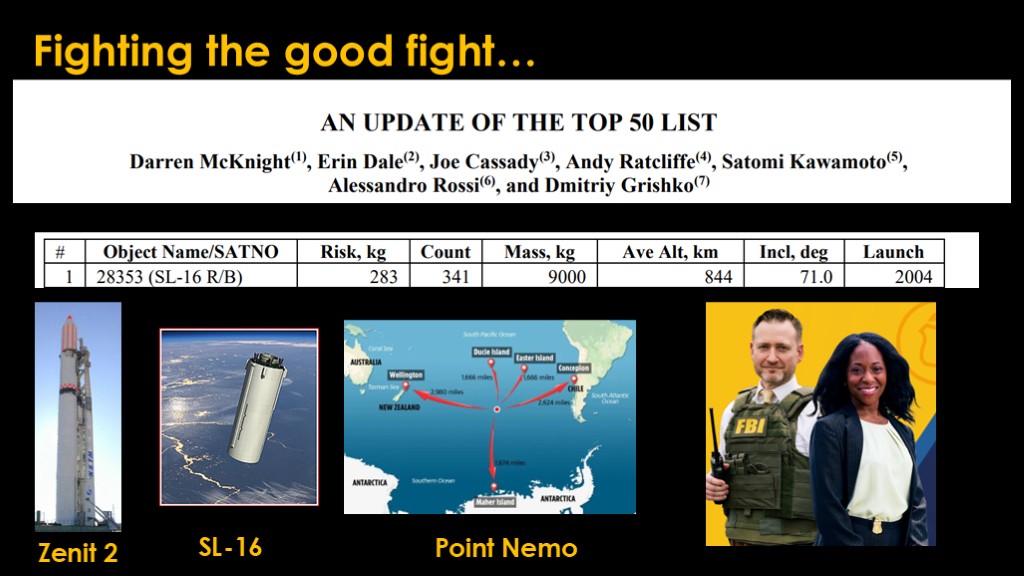
There's a group that looks at space objects, ranks them according to the amount of long-term collision risk, and publishes a top 50 list. You grab the object at the top of the list - it turns out to be an SL-16 rocket body, the second stage of a Russian Zenit rocket, orbiting at around 840 kilometers.
Your tug attaches to the rocket body and changes its orbit so that it reenters the atmosphere and hits the ocean at point nemo in the south pacific, the main satellite graveyard.
You then get visited by agents from the FBI who tell you that you have broken both US and international law.
Top 50: McKnight paper, ars technica article: https://www.sciencedirect.com/science/article/abs/pii/S0094576525009002
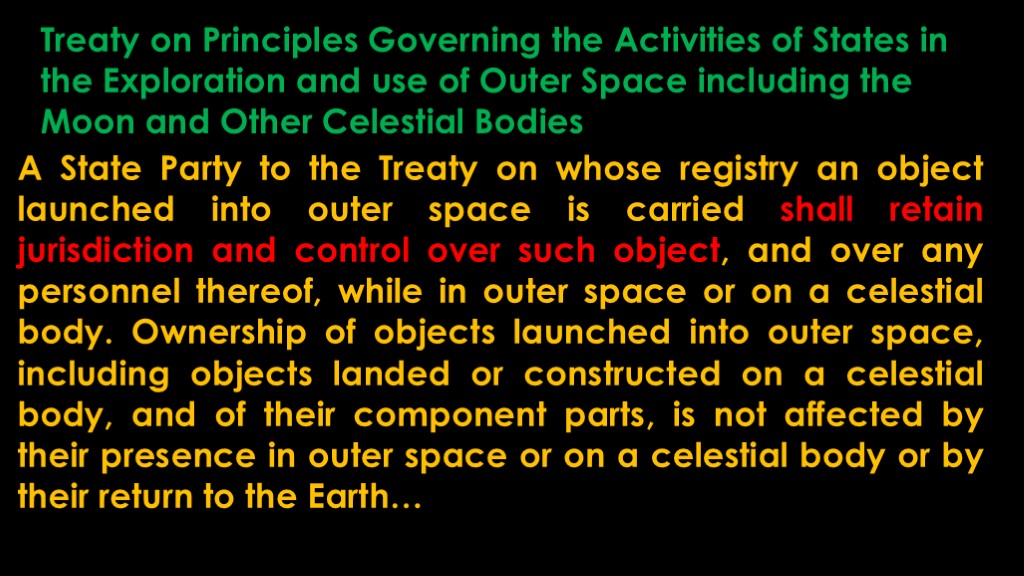
Space is governed by a number of treaties. The first is known as the outer space treaty of 1967. Its full name is
(read)
Article VIII of the treaty says the following:
(read)
The Zenit rocket was launched in Kazakhstan but the rocket itself was registered with the Commonwealth of Independent states, Russian plus allied states.
That means the derelict rocket body is their property and you have both stolen it and destroyed it. This does not look good for you.
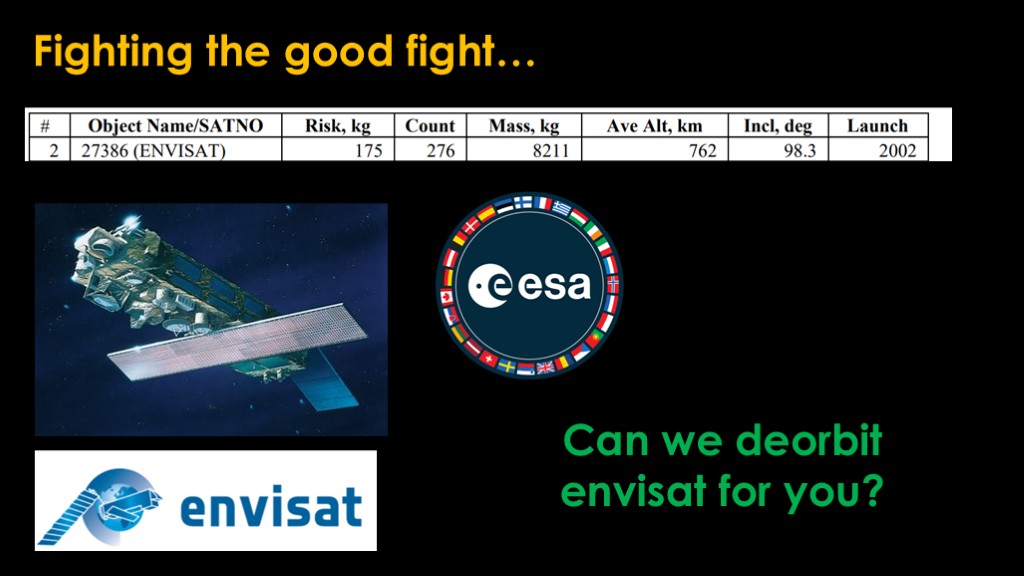
Let's try again...
The number two entry on the list is an earth observation satellite known as envi sat, launched in 2002 and inactive since 2012.
It is registered to the European space agency. That isn't actually a state under the 1967 treaty, but neither is the commonwealth of independent states.
You go to ESA and ask, "can we deorbit Envisat for you?"
How will they respond?
At this point I should probably make a couple of things straight.
First, I am not a lawyer...
Second, the rules in space are defined by a set of treaties - mostly old ones - and legal opinions differ on how those treaties might apply to different situations.
That's a good thing for the lawyers in terms of billable hours but means that there aren't definitive answers to some of the things I'll talk about.
Back to Envisat...
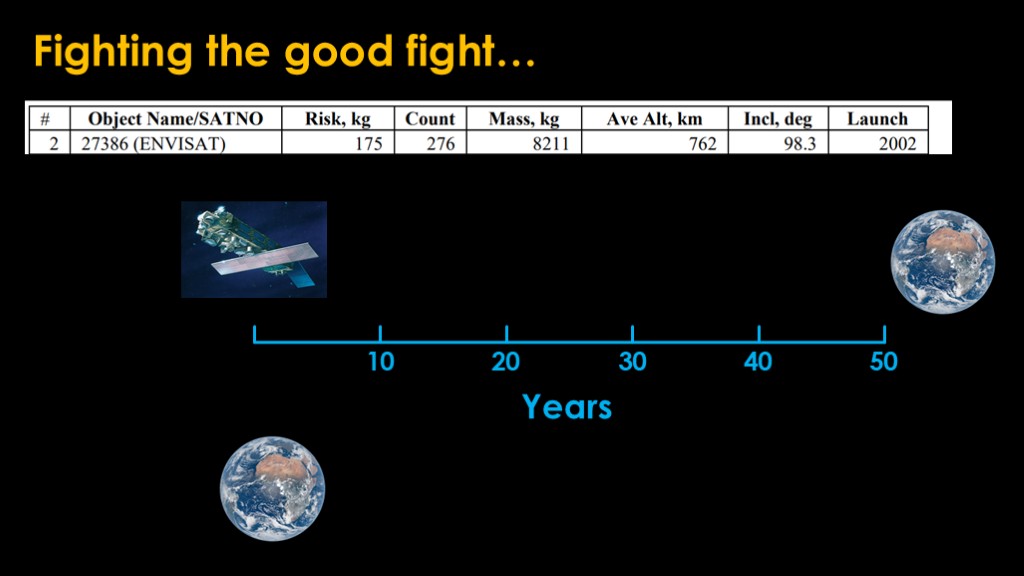
Envisat is in a high orbit at about 750 kilometers, and that means it likely has at least 50 years hanging around in orbit until it finally reenters the atmosphere.
Our proposal is that we will crash Envisat into the ocean in the near term - let's just say that it's within a month - and we will aim to put it into the satellite graveyard.
Seems like there's no reason for ESA not to accept our proposal.
Except that space law is weird.
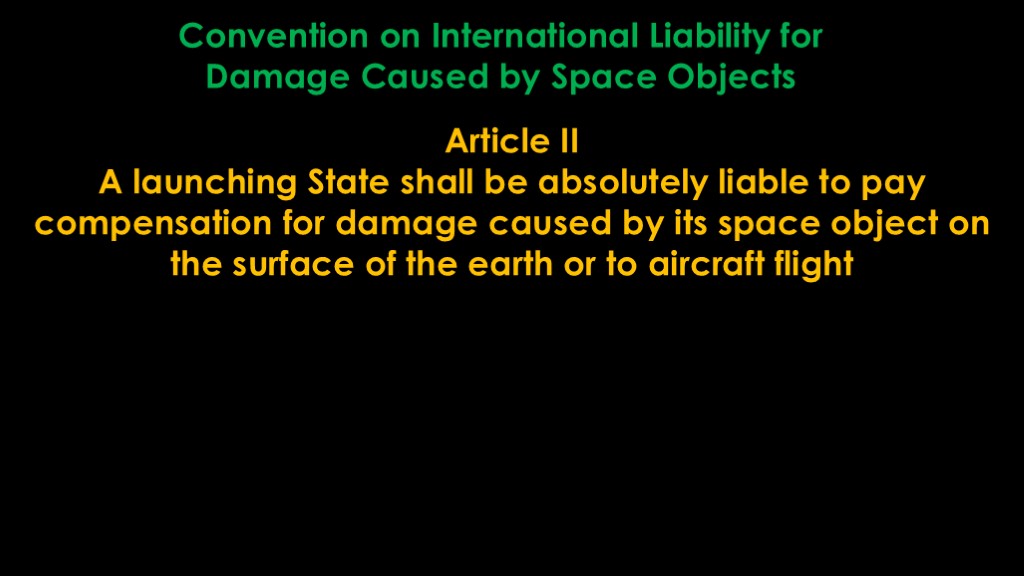
We'll need to look to the 1971 convention for international liability for damage caused by space objects.
It has two relevant sections.
Article 2 says the following:
(read)
If your spacecraft hits an airplane or does damage on the ground, you are liable for the damages.
Has this happened?
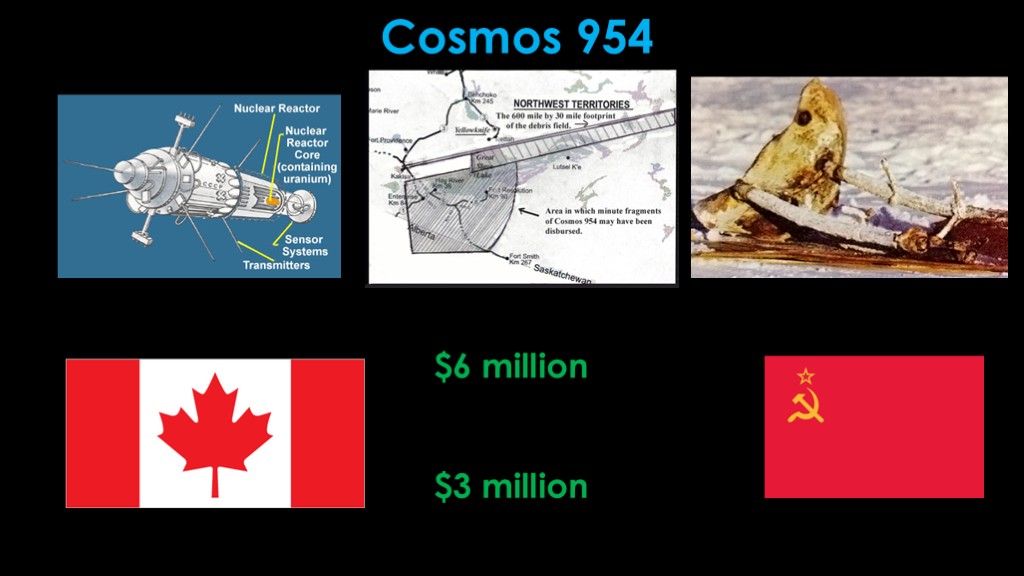
The answer is yes.
In January of 1978, the Nuclear powered Soviet Satellite cosmos 954 reentered and scattered radioactive material over Canada.
Under the treaty, Canada submitted a claim for $6 million to help pay for cleanup of the material.
The soviet union offered to pay $3 million, and Canada accepted.
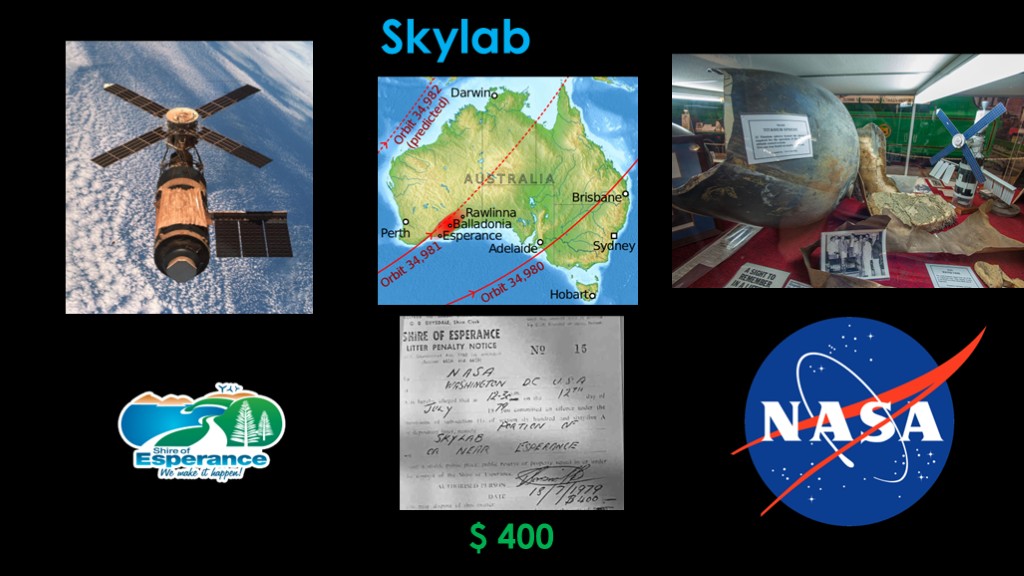
In 1979, NASA's skylab orbital laboratory reentered and scattered debris over southwestern Australia.
There was no damage to people or property, so the Australian government did not pursue a claim, though the shire of Esperance did issue NASA a $400 ticket for littering, which NASA declined to pay.
We therefore know that ESA will be liable for any damage that Envisat causes during reentry.
What about the 50 years that it will spend as a navigational hazard?
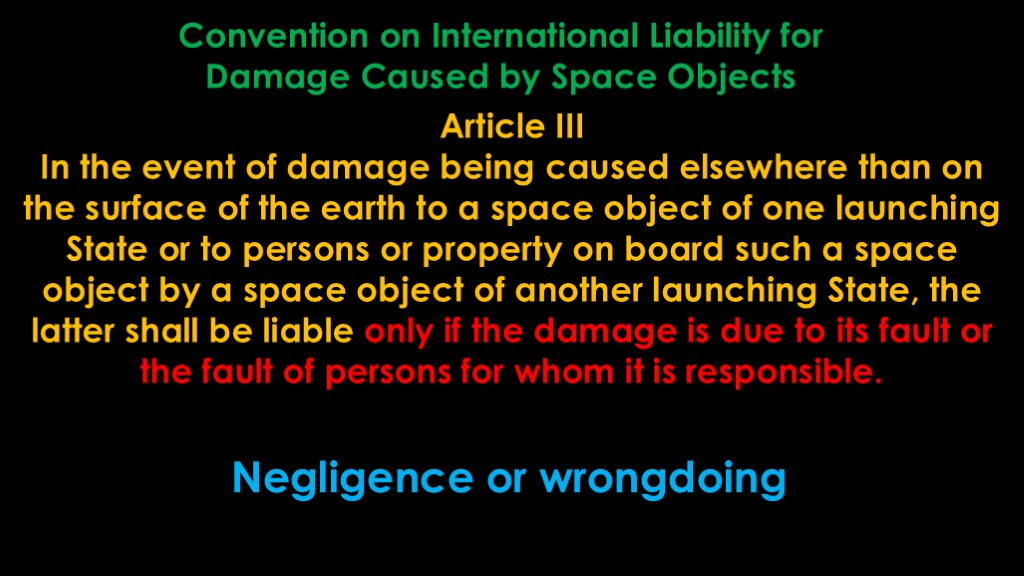
Article III covers damage in space
(read)
What does "due to its fault" mean?
It likely would require a way to show either negligence or wrongdoing.
We have a test case for this.
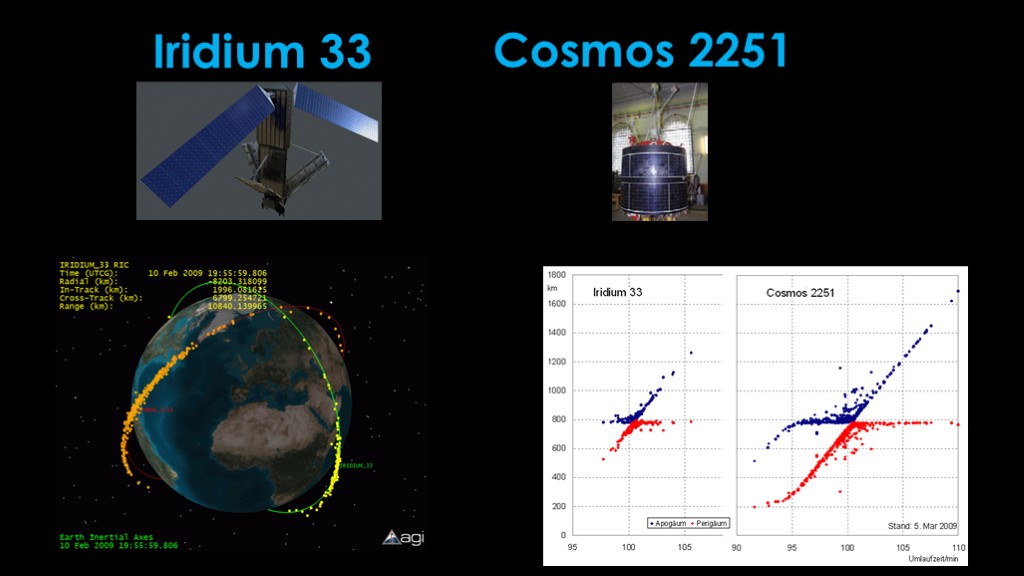
I discussed the collision of iridium 33 and cosmos 2251 in the first video of the series. Who was at fault in that collision?
Cosmos 2251 was a derelict satellite with no way to adjust its orbit, just one of thousands of derelict spacecraft and rocket bodies. There was no international requirement for it to be deorbited. And therefore the argument can be made that the operators of Cosmos 2251 are not liable because they were not negligent nor did they do something wrong.
To put it another way, as the functional satellite, Iridium 33 should have moved out of the way of Cosmos 2251.
Iridium did not make a claim against Russia after the collision.
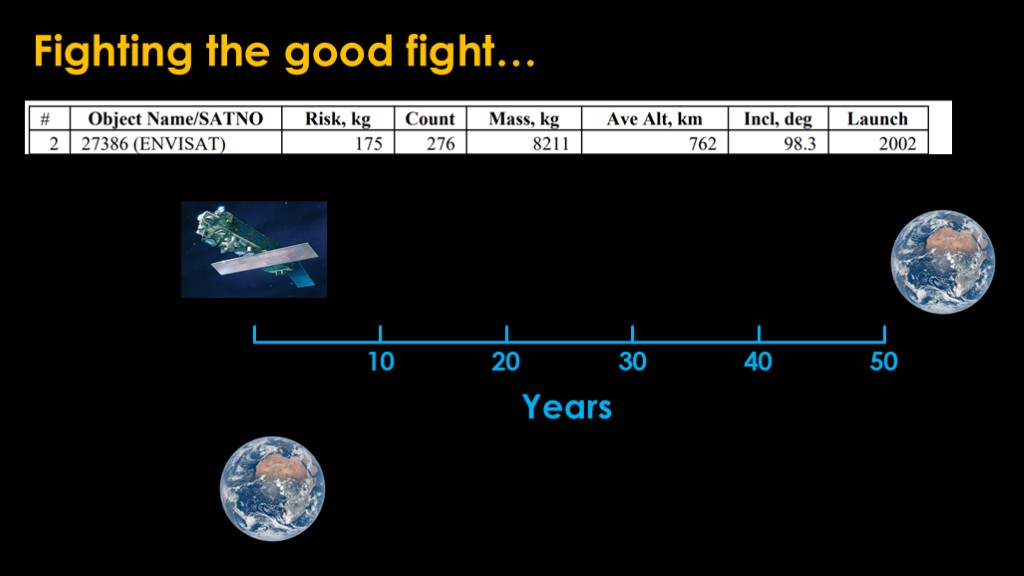
Let's return to envisat.
With the status quo, ESA doesn't have to worry about any legal risk for the next 50 years and then they have a small amount of exposure when reentry actually happens, but that is many decades in the future and it's very likely that nobody high up in ESA will still be there in 50 years time.
It's a situation that ESA is currently not worrying about.
In the alternate case, the reentry will happen a month from now, which pulls the possible liability of reentry from 50 years away to next month.
Worse, if you are using a space tug to deorbit the satellite, one can argue that it is no longer a derelict and it is therefore possible that an orbital collision might be judged to be ESA's fault.
It might be possible to ensure against these risks but it will be difficult to quantify the risks and therefore to price the insurance policy. It is hard enough to price launch insurance when the cost of the satellite and the reliability of the launch vehicle are well known.
To summarize...
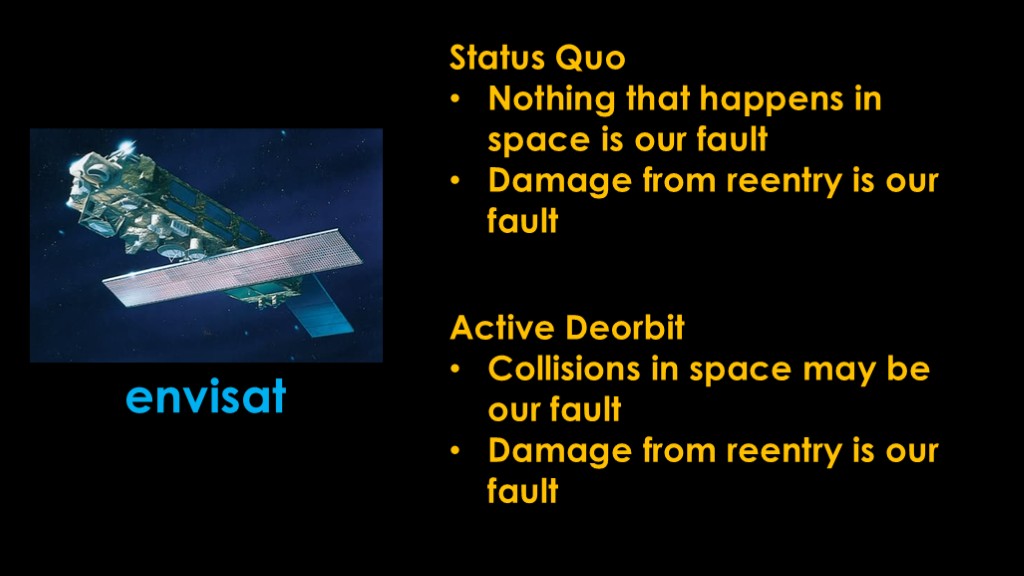
The status quo for ESA is that nothing that happens in space with envisat is their fault, and any damage from reentry is their fault, but reentry is many decades in the future so it's somebody else's problem.
If you are actively deorbiting Envisat, you can no longer make the argument that you don't have control over it and therefore any collisions in space might be your fault. And any damage from reentry is now a near term problem.
You've therefore taken a comfortable if unfortunate situation and turned it into a riskier situation where you have additional liability.
This is by no means settled law and the particulars are going to depend on what technology is used to perform the deorbit, but uncertainty always pushes organizations towards the status quo.
ESA might choose to tell you no.
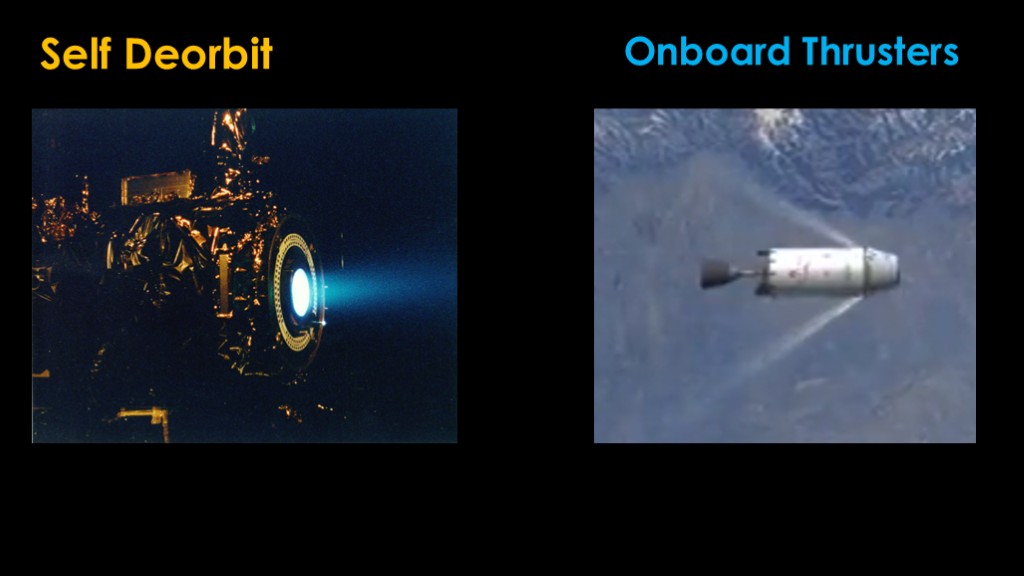
Let's transition from the legal area to the technical side of deorbiting. I'm going to start by talking about self deorbit.
New LEO satellites that are launched from the US and some other countries need to be able to deorbit within 5 years when their mission is over, as do LEO rocket bodies. Satellites that are above about 500 kilometers will generally need an active system to perform that.
The simplest approach is to use the on-board thrusters to perform a propulsive deorbit of the object quickly enough so that the impact point on the earth's surface can be targeted. This of course requires that sufficient propellant be reserved to achieve this and that can reduce the usable life of the spacecraft.
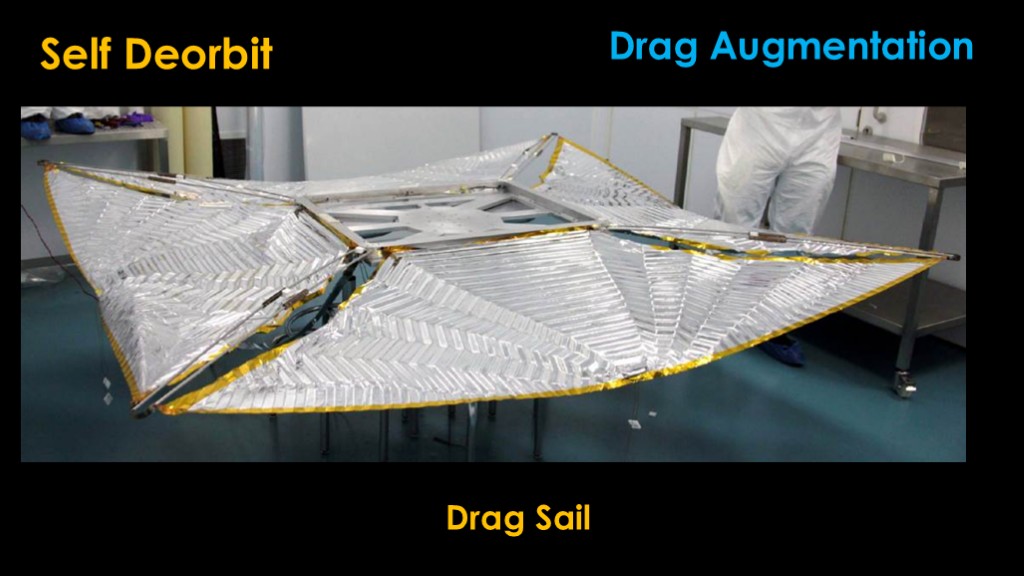
The next category is drag augmentation. The idea here is to drastically increase the drag experienced by the satellite so that it will deorbit more quickly.
A drag sail is a deployable panel.
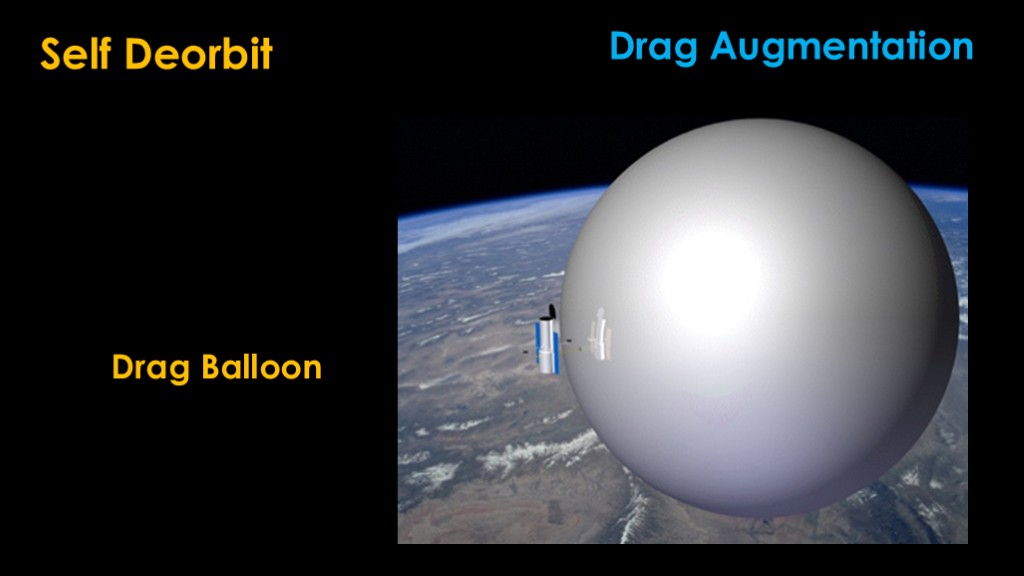
There is also the Drag Balloon, which uses an inflatable balloon many times the size of the satellite.
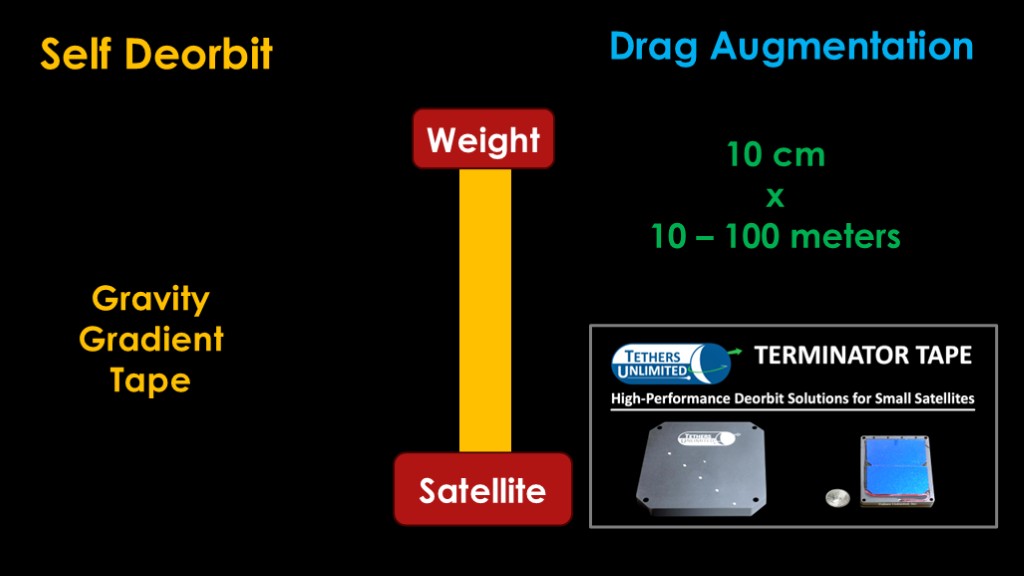
The gravity gradient tape uses a weight attached to the satellite by a long wide tape. Because of the way orbital dynamics works, the two masses will stretch the tape out into a stable position.
The tape is perhaps 10 centimeters wide and 10 to 100 meters long. The stable orientation means that the tape is naturally aligned into high drag orientation.
This solution is commercially available for small satellites.
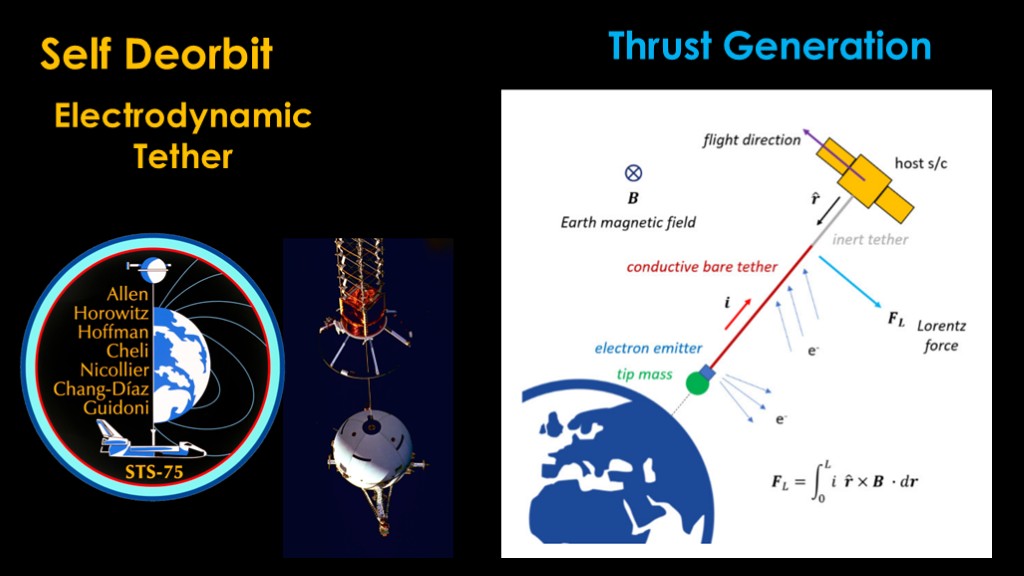
There is also - a thrust generation device known as an electrodynamic tether.
A long electrically conductive tether is deployed from the satellite, and the motion of the tether in the earth's magnetic field generates a force against the direction of the orbit. It provides free low-level thrust on the order of 0.1 to 1 newton.
The electrodynamic tether does not rely on atmospheric drag and therefore continues to function well in higher orbits, unlike the drag augmentation approaches.
NASA flew a mission on STS-75 in 1996 that released a 20 kilometer tether and verified that it could produce a high voltage but the tether broke prematurely.
Gravity gradient tapes can also use this effect but because of their shorter length, they cannot generate as much thrust and they mostly depend on atmospheric drag.
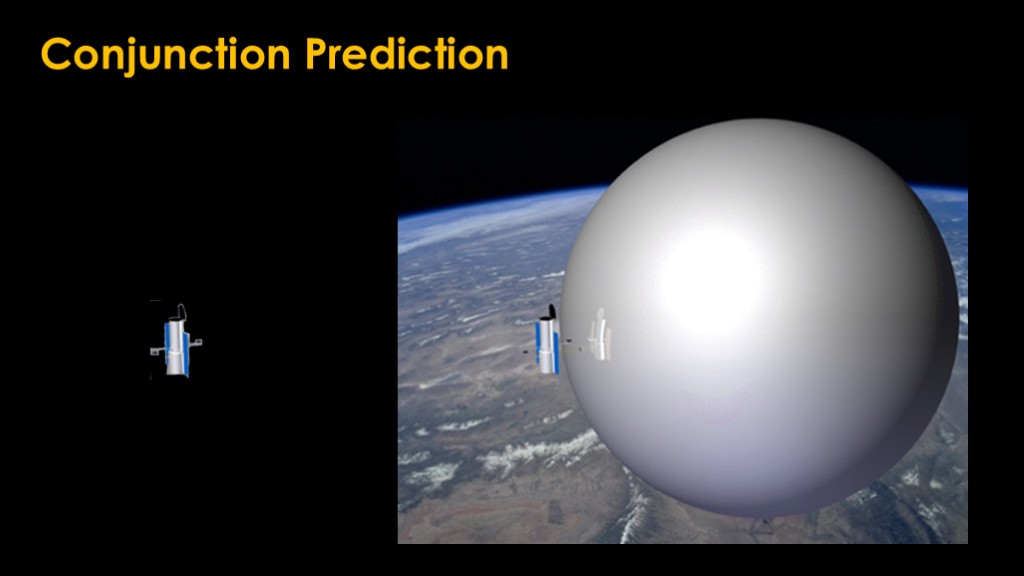
All of these approaches either make the satellite a lot bigger or deploy a long tether away from the satellite.
The current conjunction prediction models assume typical space object geometry and a fixed size for the object, and if a 3 meter satellite suddenly becomes 30 meters around that would obviously increase the collision potential. In the case of tethers, they create a two-body problem that somehow need to be solved by everybody who does conjunction prediction.
That seems somewhat problematic. You take an object that is moving in a relatively predictable manner but will be around for a long time and replace it with an object that moves in a less predictable manner but will be around for a shorter time.
Is the owner of the object responsible because they actively changed the characteristics of the object? That's a question for the lawyers.
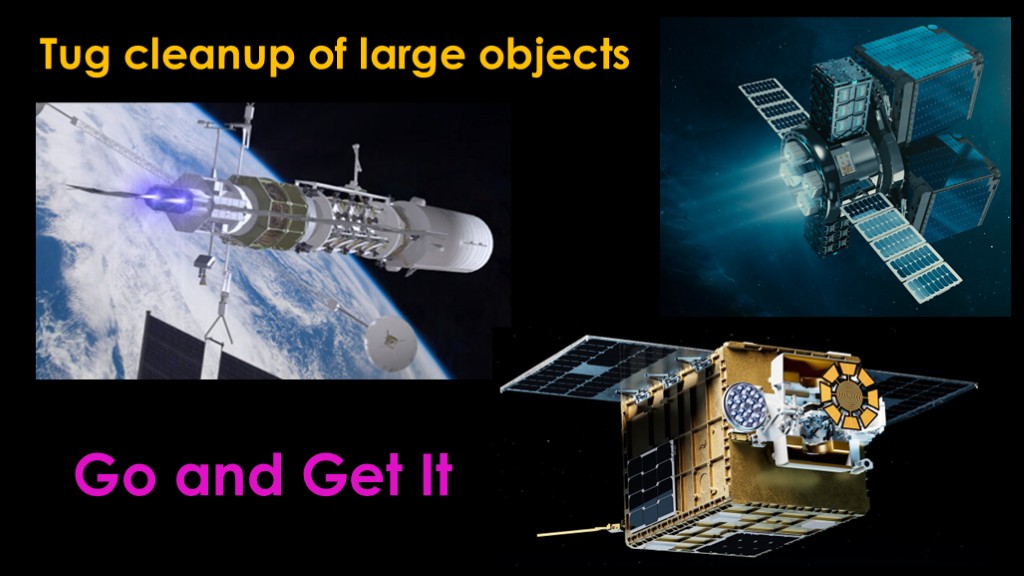
Self disposal can be good for new satellites, but what about all the derelicts that are hanging around?
Space tugs have often been proposed as a solution to this - what I call the "go and get it" approach...
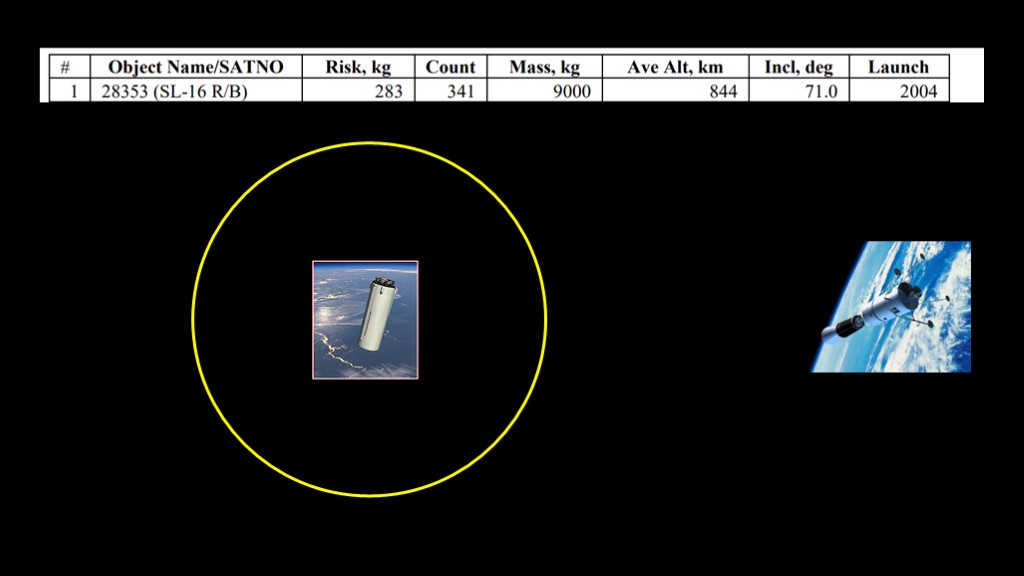
Let's go back to the SL-16 stage that we talked about initially, and assume that we have permission to deorbit it.
And our space tug is up and running. We launch into an appropriate orbit and navigate our tug towards the booster.
But when we near the stage, we realize that we have a problem.
These rocket stages have no active control, and that means that they aren't floating stably in space, they are rotating and tumbling. To actually rendezvous - to be able to attach something to the object - our tug needs to fly a path around the object at the rate that it is rotating.
At this point we could attach a drag enhancement device or we could try to directly deorbit the stage.
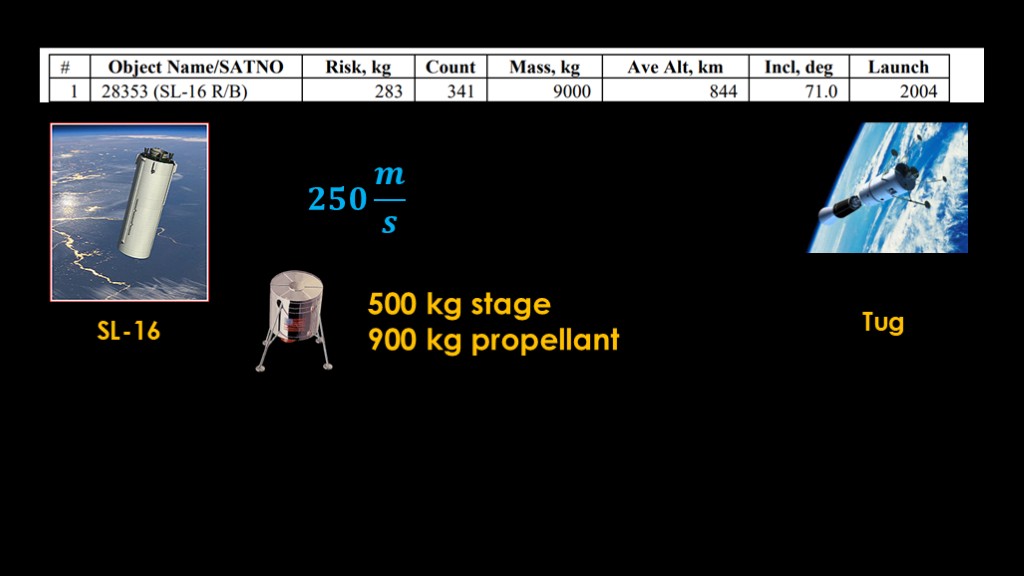
Let's go back to the SL-16 state that we talked about initially, and assume that we have permission to deorbit it.
And we have a space tug design up and running.
(add in section on different ways of attaching to the object)
The rocket body is at about 844 kilometers at an inclination of 71 degrees, and let's just assume that our launch vehicle can put the tug right next to the rocket body. And I'm going to assume the total tug mass is 10 tons.
At this point we could attach a drag enhancement device or we could try to directly deorbit the device. The estimates I've seen suggest that it will take about 250 meters per second of delta v do the deorbit.
Assuming we have a "deorbit propulsion pack" that we can attach to the stage. If it weights 500 kilograms, it will take about 900 kilograms of propellant to deorbit the stage if we are using hypergolic chemical rocket engines.
We can of course go with electric ion thrusters with a higher specific impulse and do the same maneuver with perhaps 200 kilogram of propellant. We would need the mass of solar arrays on our deorbit stage and it would take a long time to do the deorbit.
But even at 1400 kilometers we can probably deorbit a few stages.
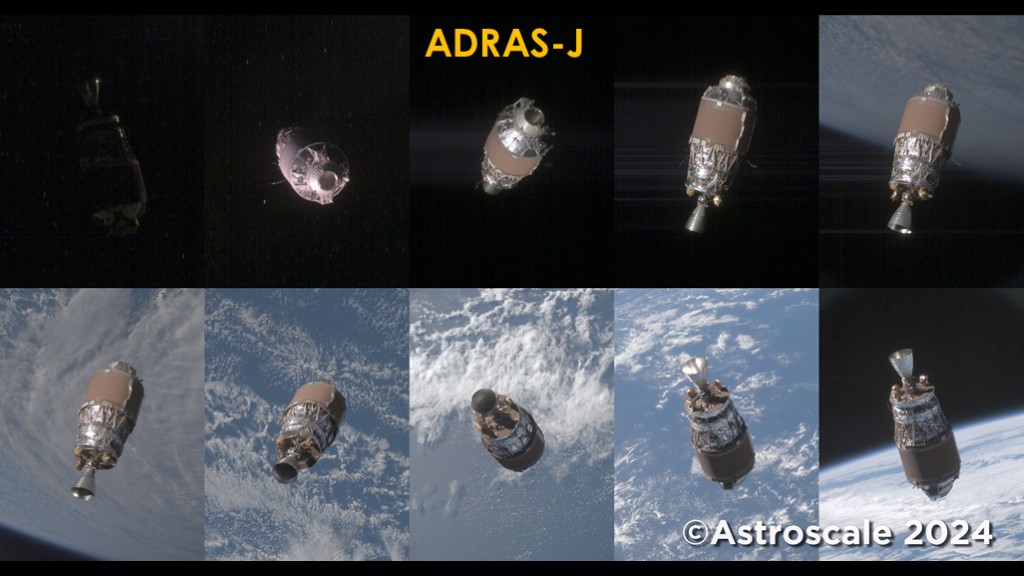
The ADRAS-J mission in 2024 made a first step towards this by coming within 15 meters of a derelict Japanese rocket stage and orbiting around it under power.
We'll assume for now that actual rendezvous is possible.
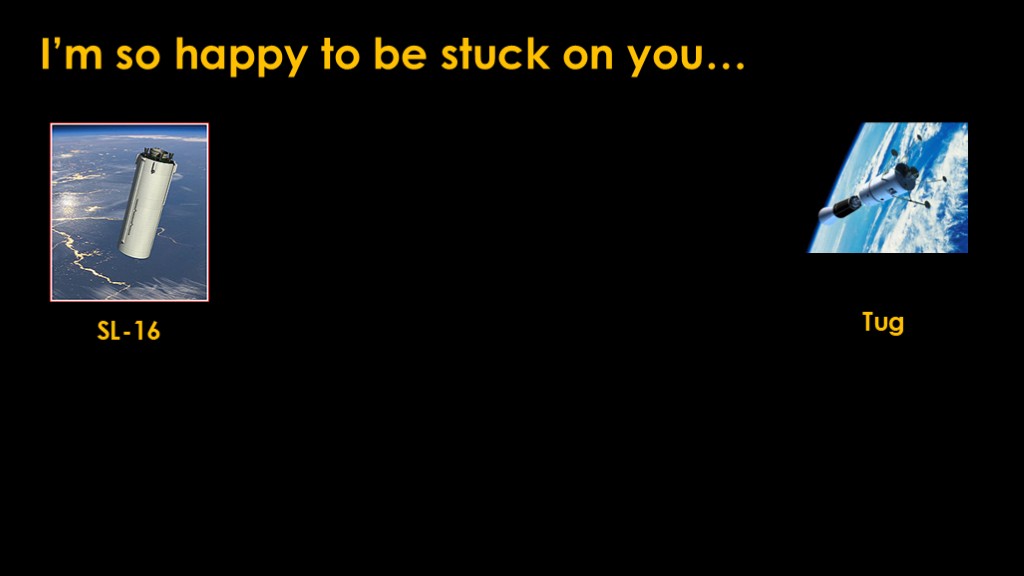
Now we need to somehow attach something to the rocket body. There are many proposed methods...
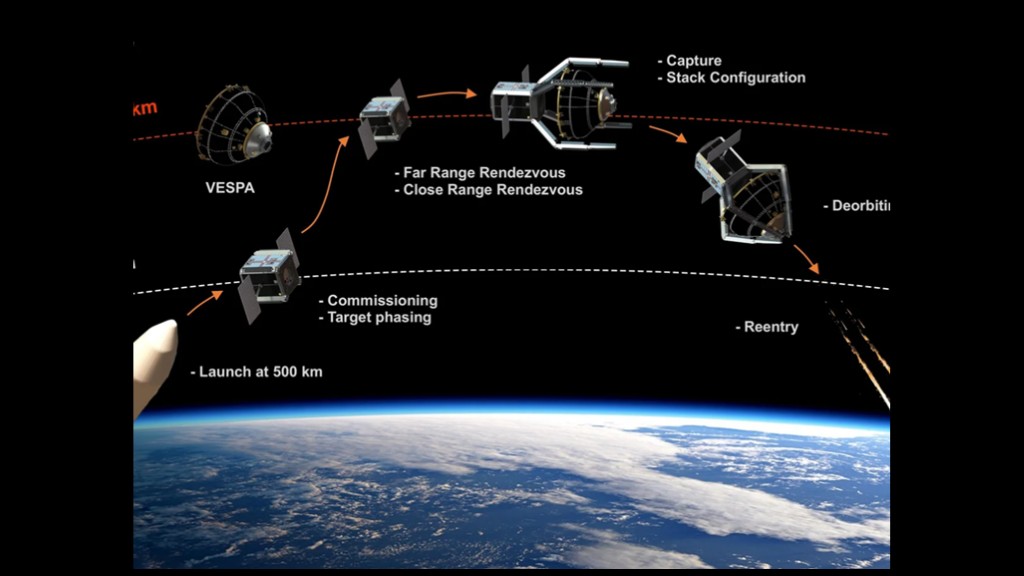
The European space agency is building a spacecraft that will surround a piece of space debris and hold onto it so it can deorbited, with a mission planned for 2029.
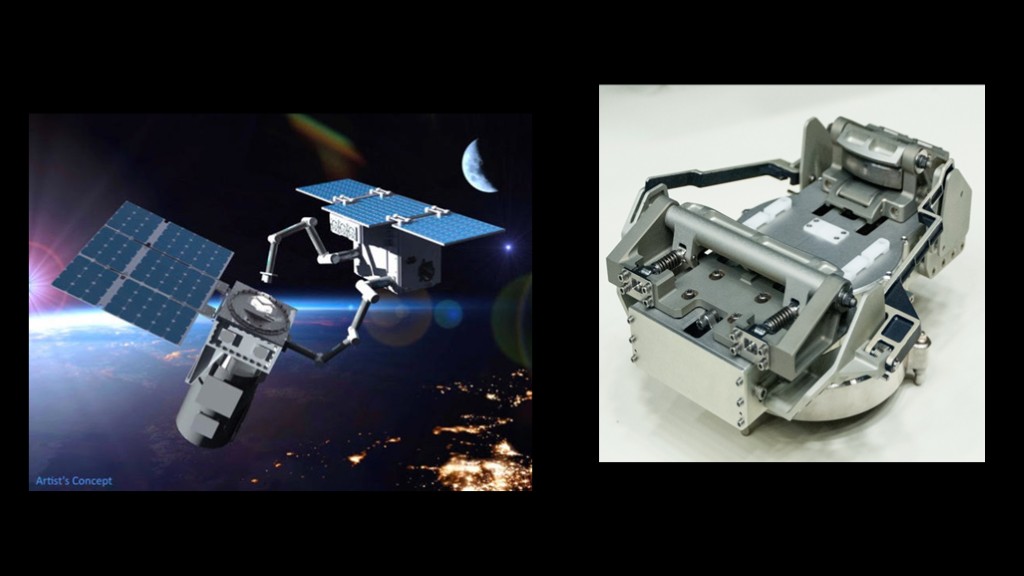
A tub might also directly grapple onto a target object.
It might use a mechanical grabber.
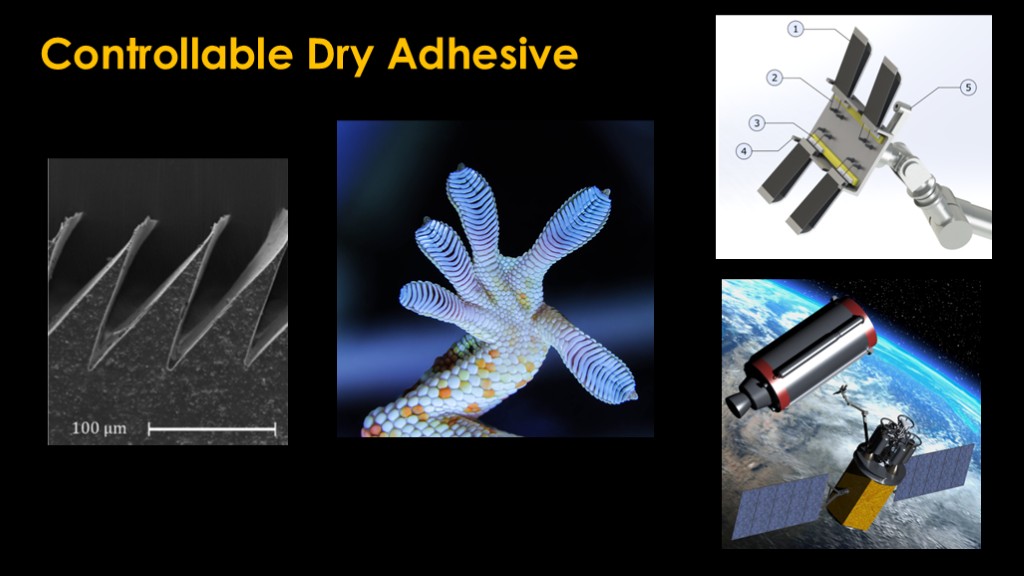
It might use an approach called controllable dry adhesive, which is inspired by the pads that geckos use to stick to surfaces.
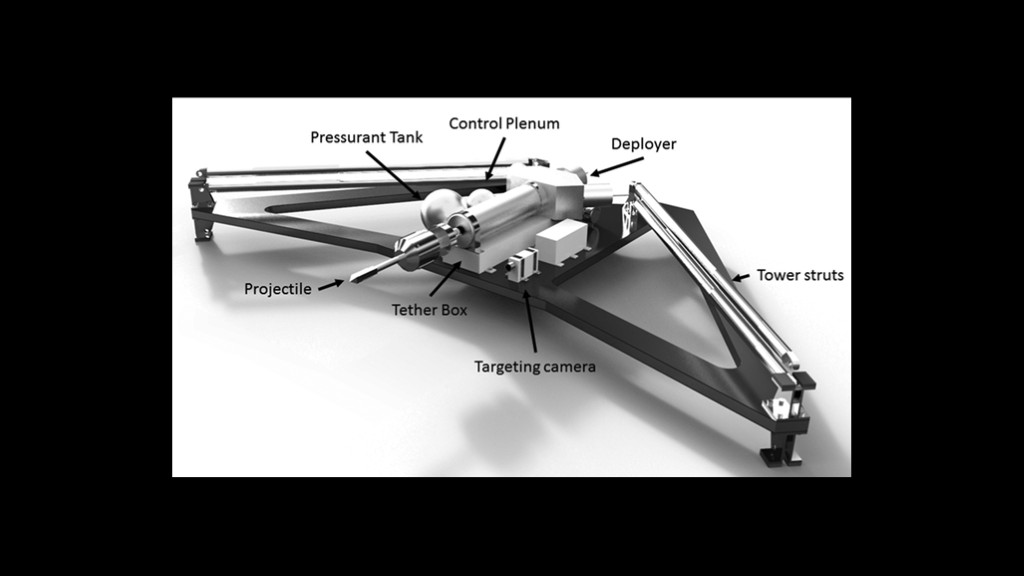
It might fire a harpoon into the object and reel it back.
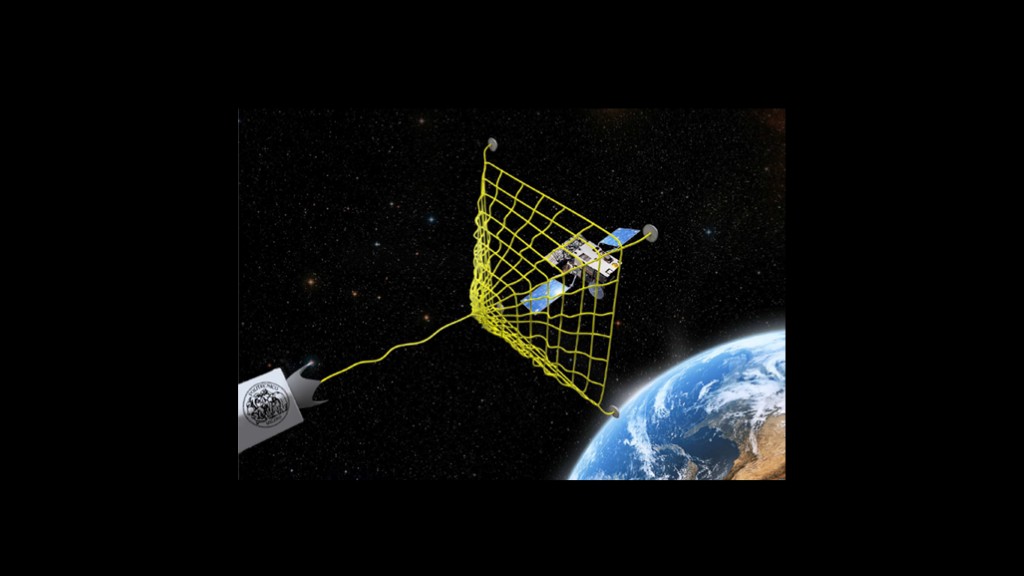
Or a net might be fired to engulf and trap the object.
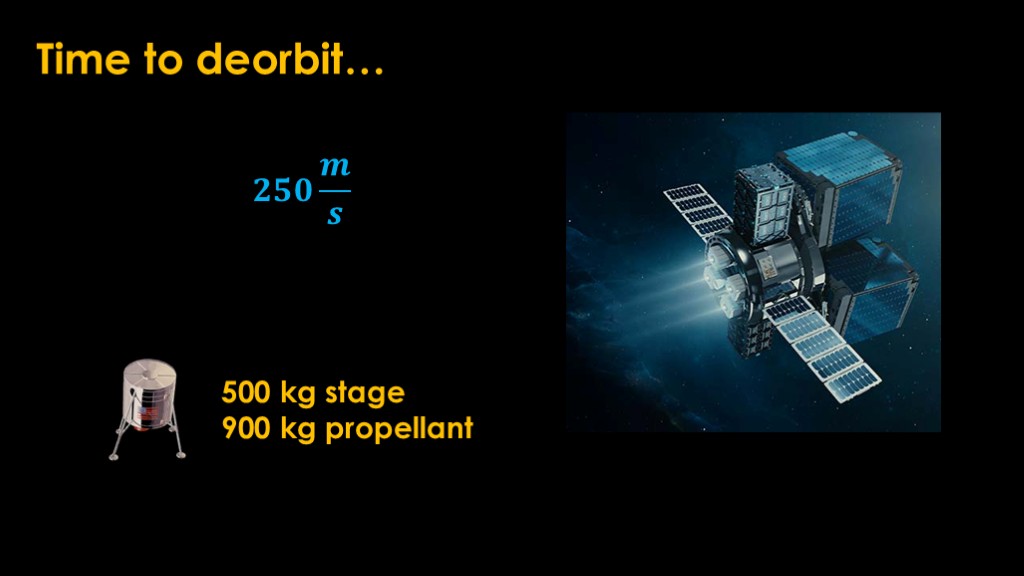
Once attached, it's time to deorbit the object. It generally only takes a small amount of delta v - only about 250 meters per second.
You can do this with your tug, but remember that if your tug puts the object into a reentry trajectory, your tug is now in that same trajectory and you need to get out of it, which takes more fuel.
It can also be done using a small deorbit stage - if you use hypergolic propellants you can deorbit using a 500 kilogram deorbit stage and 900 kilograms of propellant. You can probably build a lighter version using ion thrusters, though you'll need solar panels and the deorbit will take a long time.
Or you could also just attach one of the drag enhancement devices to the object and be done with it.
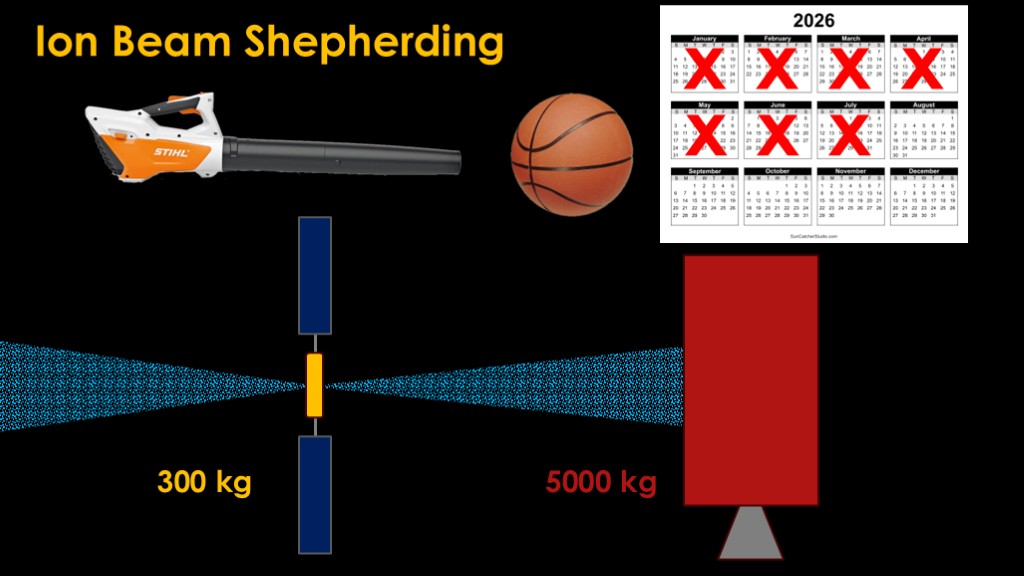
There's another approach that is contactless.
If you took your leaf blower, pointed it at a basketball, and turned it on, the air from the blower would push the basketball to the side.
If we take our space tug and point its ion engine at a derelict stage, the ion exhaust from the engine will hit that stage and make it move. Very slowly, as ion engines only produce millinewtons of thrust.
This concept is known as ion beam shepherding
The thruster will also move the tug away from the stage, so the tug will need a more powerful thruster on the opposite side to counteract the first thruster and keep the tug the same distance from the stage.
A European Space Agency team published a detailed study on this technique in 2011. Their conclusion is that it's possible to deorbit a 5000 kilogram object with a total tug mass of only 300 kilograms. That is promising.
The downside is that the low thrust means that it takes a *long* time to finish the deorbit operation - on the order of 7 months.
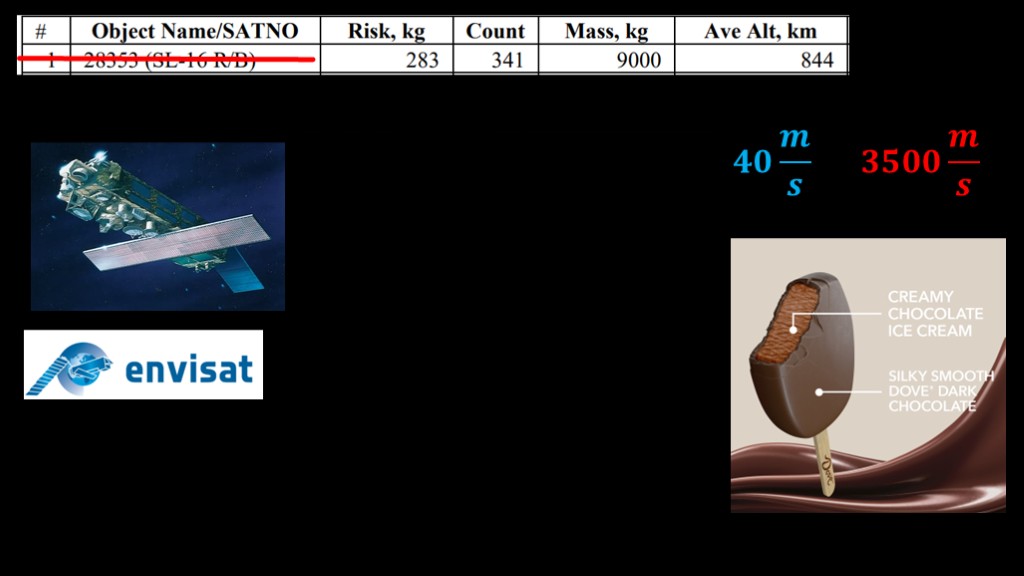
We've dealt with the pesky SL-16 rocket body, and now we want to move onto the second object in the list, which is of course our old friend envisat. I'm assuming that our tug is still in the SL-16 orbit.
Envisat is in an orbit that's a little lower, but it only takes about 40 meter per second of delta v to get to that lower orbit.
It turns out, however, that these objects have a significant difference in orbital inclination, as you can see in this animation from zerua.space.
Doing a bit of math, we discover that
Getting our tug from the SL-16 inclination to the envisat inclination will take about 3500 meters per second of delta v.
Ouch.
The problem is that we need to twist the orbital plane of our space tug from 71 degrees to 98 degrees, and that is really expensive.
If anybody was already thinking "orbital inclination changes in LEO are really expensive", take $3 from petty cash and buy yourself a dove bar. I recommend chocolate ice cream with dark chocolate coating.
We interrupt this video with a pop quiz. I hope you all studied.
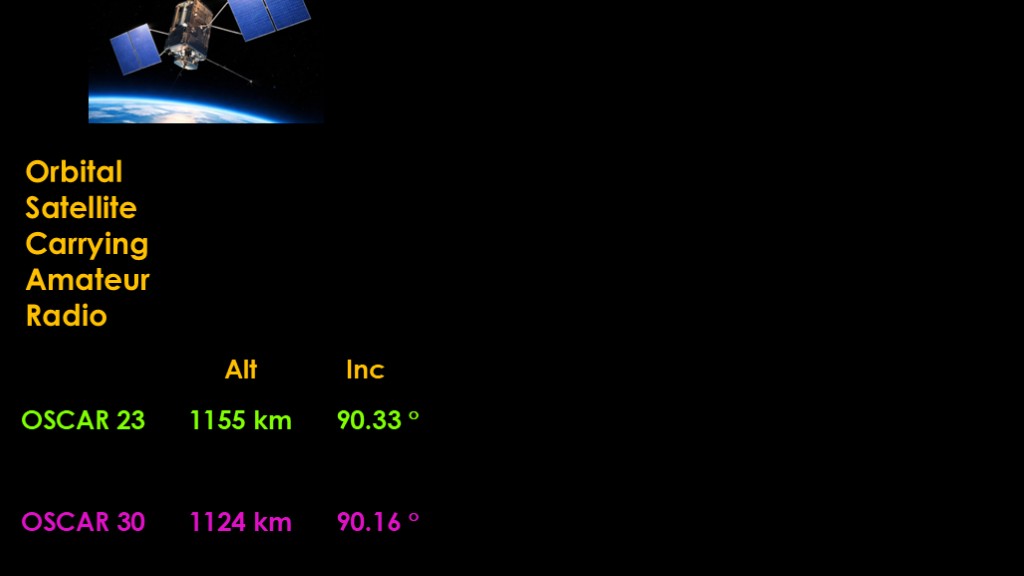
There are amateur radio satellites from the orbital satellite carrying amateur radio series - otherwise known as Oscar.
Oscar 23 has an average altitude of 1155 kilometers.
Oscar 30 has an average altitude of 1124 kilometers.
Here are the orbital paths of these two satellites. What can you say about the inclination of the two satelites?
It turns out that Oscar 23 is in almost a pure polar orbit at an inclination of 90.33 degrees.
Oscar 30 is at an inclination of 90.16, or pretty much an identical orbit.
It turns out that inclination is only part of the story.
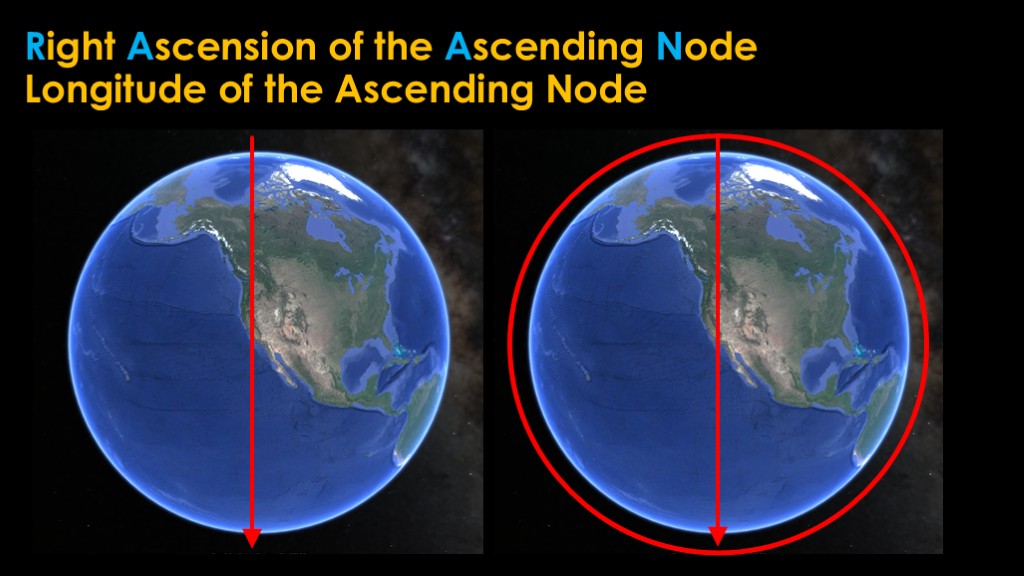
Let's say that we are launching from Vandenberg space force base in California into a polar orbit. The path of the rocket will be to the south into this orbit...
Then we wait 6 hours. During that time, the earth rotates 90 degrees and the satellite keeps following the path it was launched into.
If we launch again using the same trajectory, we will end up with the second satellite in an orbit that is at right angles to the first one when viewed from the pole.
Inclination tells us the angle of the orbit in relation to the equator. It does not tell us how it relates to other orbits at the same inclination.
The amount that the orbit is twisted around the axis of the earth is known as the right ascension of the ascending node, or the longitude of the ascending node.
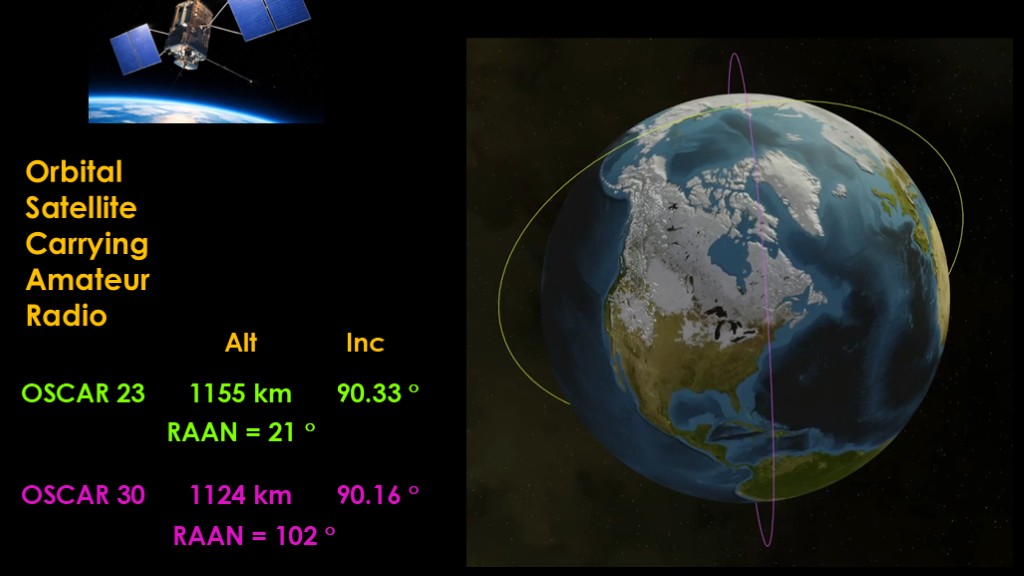
Going back to OSCAR, we see the RAAN of Oscar 23 is 21 degrees and the RAAN of Oscar 30 is 102 degrees, or about 80 degrees different, which is what we see in the animation.
To rendezvous with a different object, we need to deal with both the inclination difference and the RAAN difference to reach the correct orbital plane.
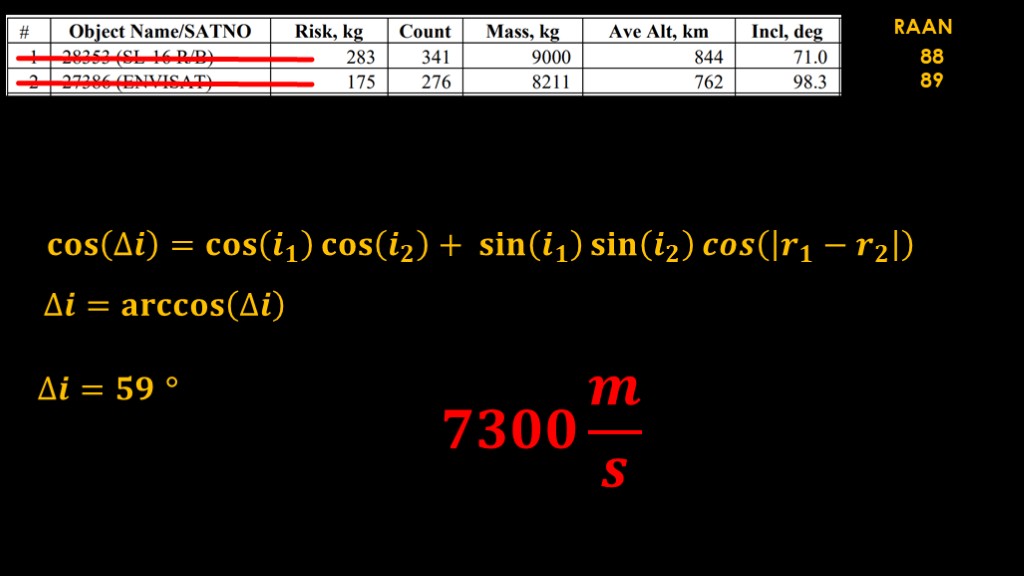
Two objects down...
Moving onto the third most dangerous object, we see that not only is there a 32 degree difference in inclination, there is a 51 degree difference in RAAN. We can combine those together with some math, and when I plug in the numbers, it turns out that the effective inclination change is 59 degrees.
Any guesses on what that will cost us?
The answer is about 7300 meters per second, which is just massive. It therefore turns out that the hard part isn't deorbiting the objects, it's getting from one object to the next.
I have of course shown you one of the worst case examples and why you shouldn't just blindly go from object to object.
What you should do is figure out the delta v between each pair of objects and then you can determine the most economic ordering for a set of objects. That will definitely help, but orbital plane changes in low earth orbit are never going to be cheap.
This is one of the problems with space tugs in LEO in general. You use a ton of propellant moving between objects.
Luckily, there aren't *that* many derelict satellites and rocket bodies. You can make a good dent in the population if the owners agree and if you can find somebody willing to pay for it.
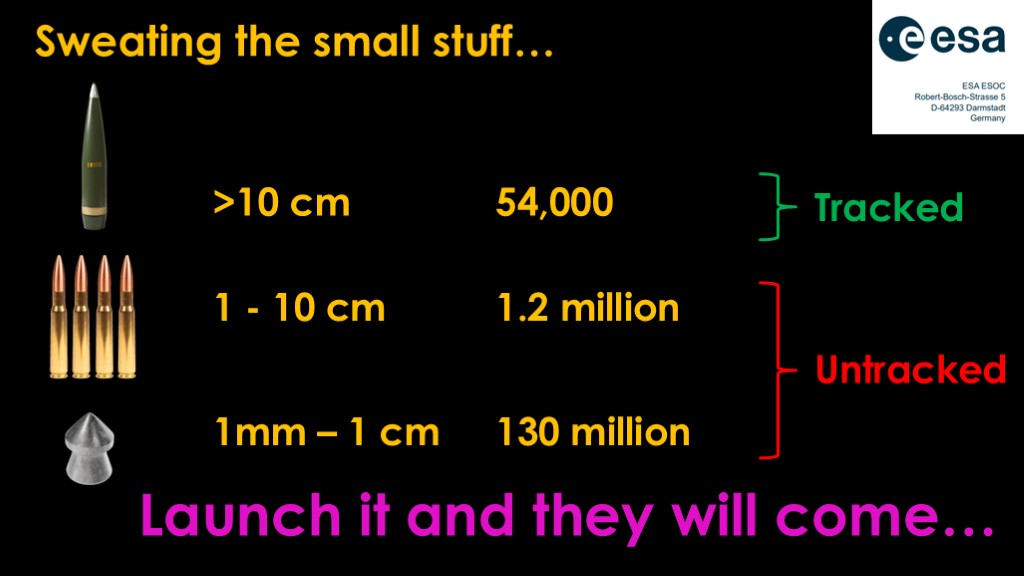
The European Space Agency puts out a very detailed space environment report annually.
As of August of 2024, they list 54,000 objects larger than 10 centimeters. That includes 9300 active payloads. These are the tracked objects.
A solid aluminum object 10cm in diameter travelling at orbital speeds has the kinetic energy equivalent to an artillery shell.
A 1 centimeter object has the kinetic energy of 4 50 caliber machine gun rounds, and there are an estimated 1.2 million objects in the 1 to 10 cm range .
A 1 millimeter object has the kinetic energy of a high power air rifle round. There are an estimated 130 million of these.
We need a solution for those objects, especially those in the 1-10 cm range. There have been a number of concepts proposed.
Because these objects are largely not tracked and we couldn't afford the propellant to move around to get them, these concepts use the "launch it and they will come" approach
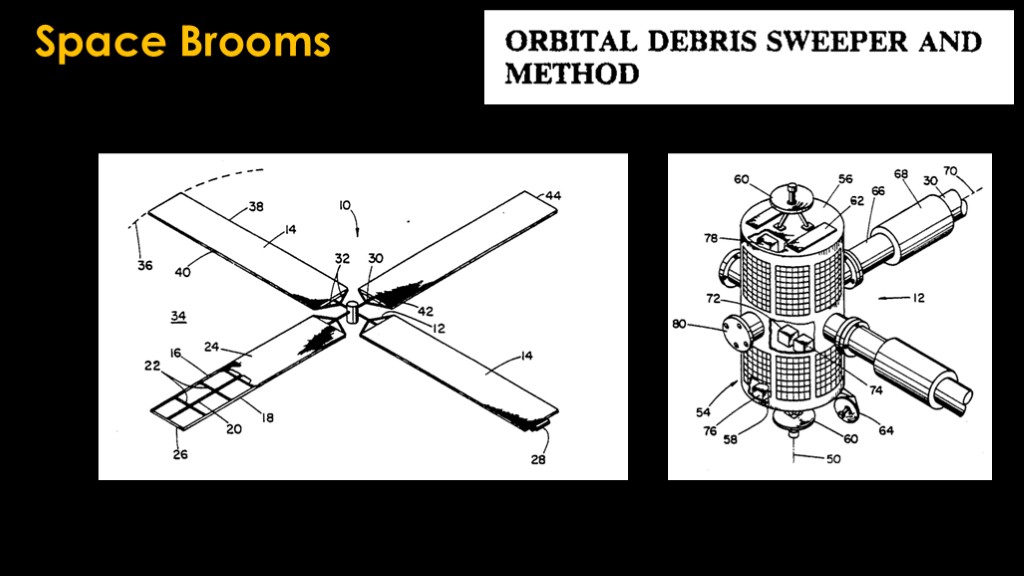
There are a number of what I'd call space brooms.
This one is called an orbital debris sweeper. It uses a number of booms that rotate around a central satellite core.
These booms are constructed so that small fragments will be contained within the boom, therefore reducing the orbital debris population. There is a problem, however - if a big object is on a collision path, it might take out an entire boom.
That is dealt with in an ingenious manner - some of the booms can be shortened or lengthened. If a big object is on a collision path, the satellite can change the boom length and - due to the conservation of angular momentum - that will increase or slow down the rotation of the satellite. That can be used to make sure the big object goes between the booms.
This would work but not for the size range that we care the most about.
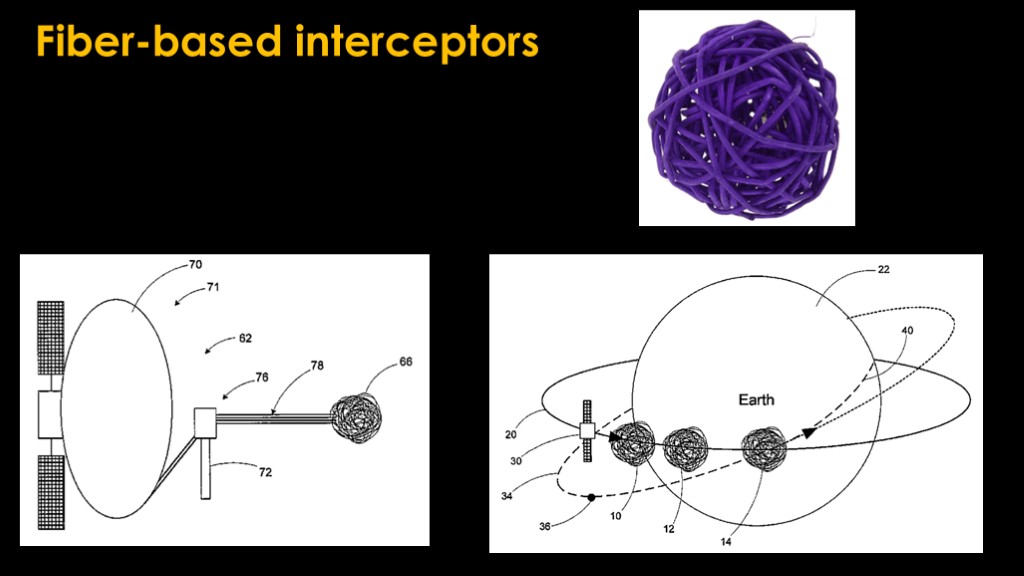
Another approach is fiber-based interceptors.
A spacecraft creates balls of fibers that are 50 meters in diameter. The fibers are made out of metal, ceramics, or plastics.
The idea is that small particles will enter the fiber ball and be trapped.
I think of these as orbital cat toys.
They also work only at the small range.
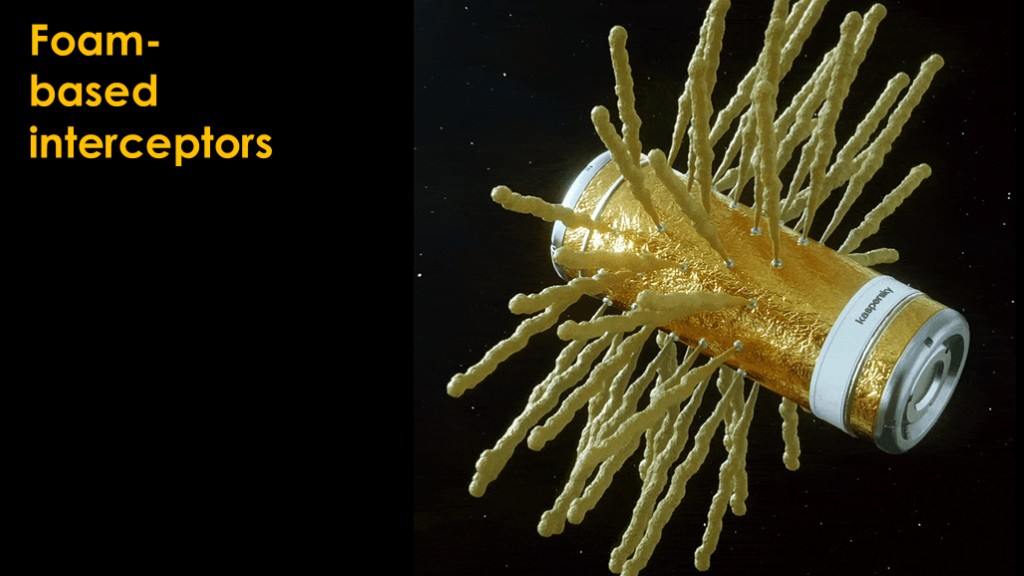
This is a satellite that extrudes foam to catch or deflect debris particles.
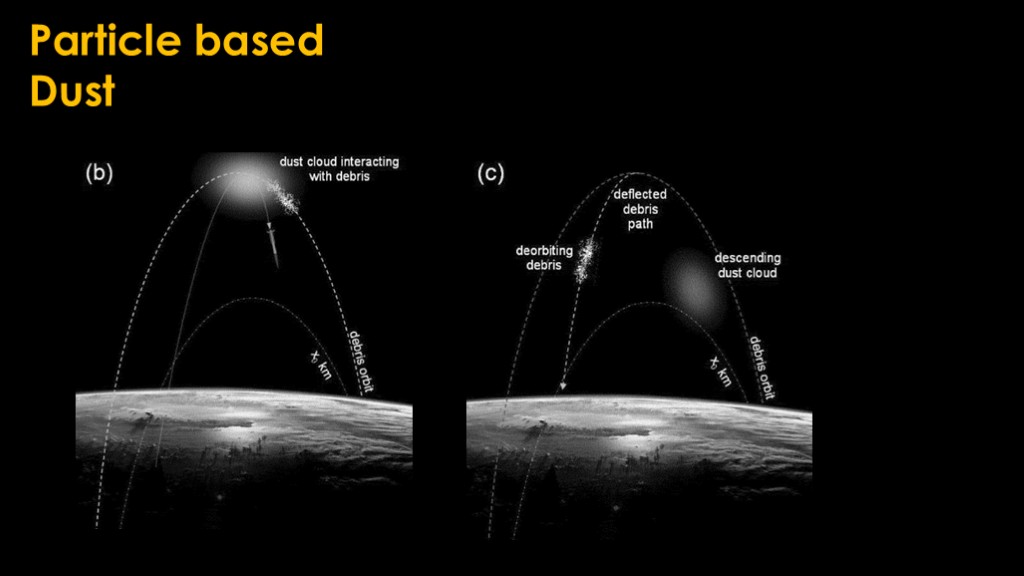
There are several approaches based on particles.
In this approach, you launch a satellite into an orbit with a path that is 180 degrees from the debris that you want to target. The dust interacts with the debris, reducing its velocity so that it can no longer stay in orbit.
Unfortunately, the bulk of the dust cloud - made out of tungsten or silicon - misses the debris and becomes a bit of a hazard for other orbital objects until it also decays.
There are similar proposals that use liquids dispersed as mists.
I'm not excited yet because we haven't addressed the most troublesome objects...
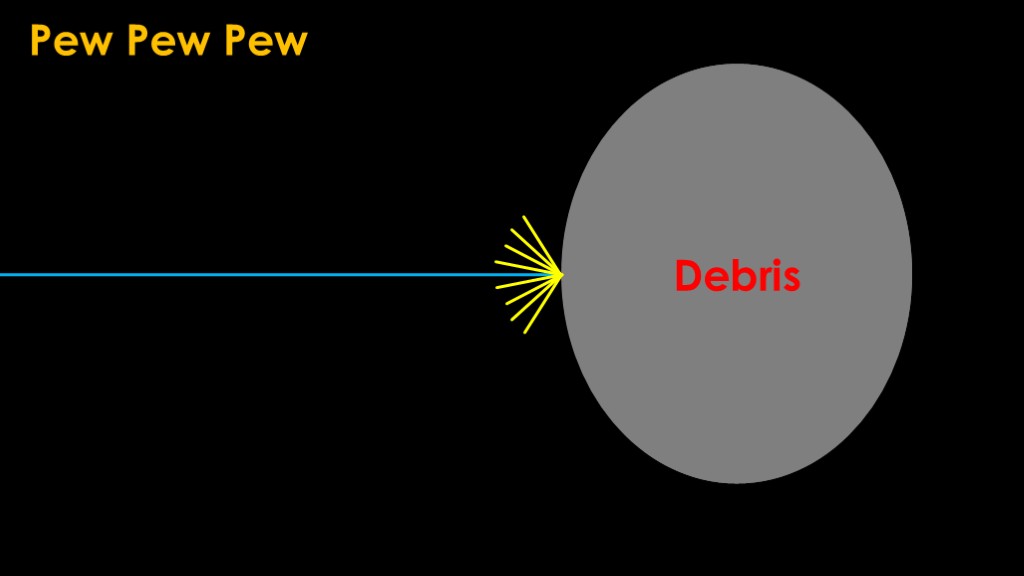
Which takes us to laser ablation.
Take a piece of space debris, and hit it with a laser beam. The surface where the beam hits will be vaporized and hot gases and particles will be propelled away from the debris.
That will generate a net thrust on the debris object and therefore alter its trajectory. The laser can hit the object on the side in the direction of travel, that will slow down the object, and if it's slowed down enough, that could cause it to reenter.
This seems like a nice approach, but is it practical?
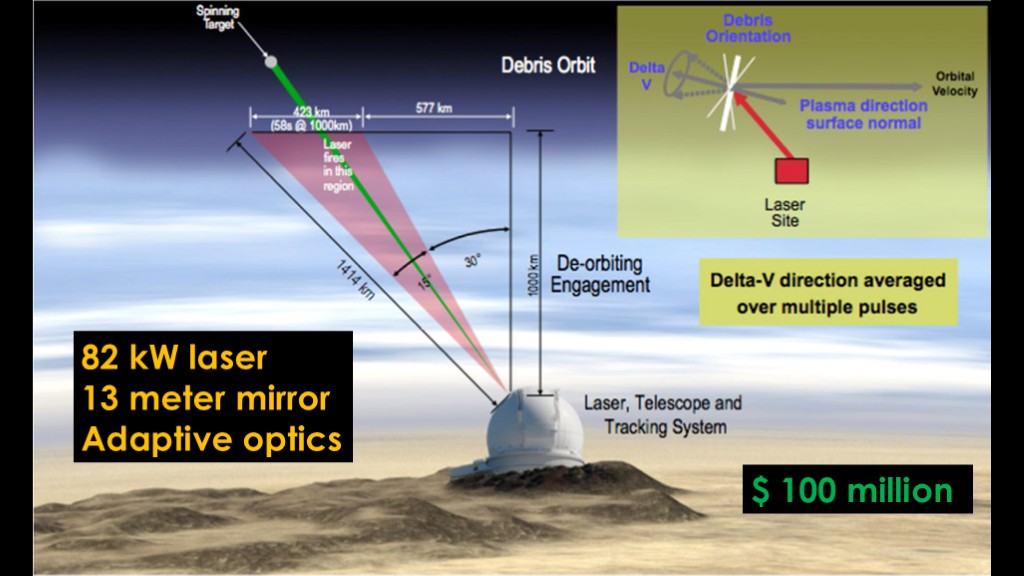
You could do this with a big laser on the ground.
The system proposed here is pretty big - it uses an 82 kilowatt laser coupled to a 13 meter telescope mirror. To keep the beam from being affected by the atmosphere too much, it will require adaptive optics - the mirror dynamically warps to counteract the way the atmosphere warps the beam.
It's hard to estimate costs for this, but based on what optical telescopes cost, this is likely at least $100 million. It could easily be 5 or 10 times that.
It has the problem that it can only address tracked object - without knowing where the object is it can't do anything. This limits the size of objects to those that can be tracked, and therefore it doesn't address the range that is most troubling.
But what if you could do this from space?
The following information is based on a 2021 paper by Pieters and Noomen at Delft university of technology in the Netherlands and a white paper from AstroSweep, a small startup working on the concept outside of Seattle.
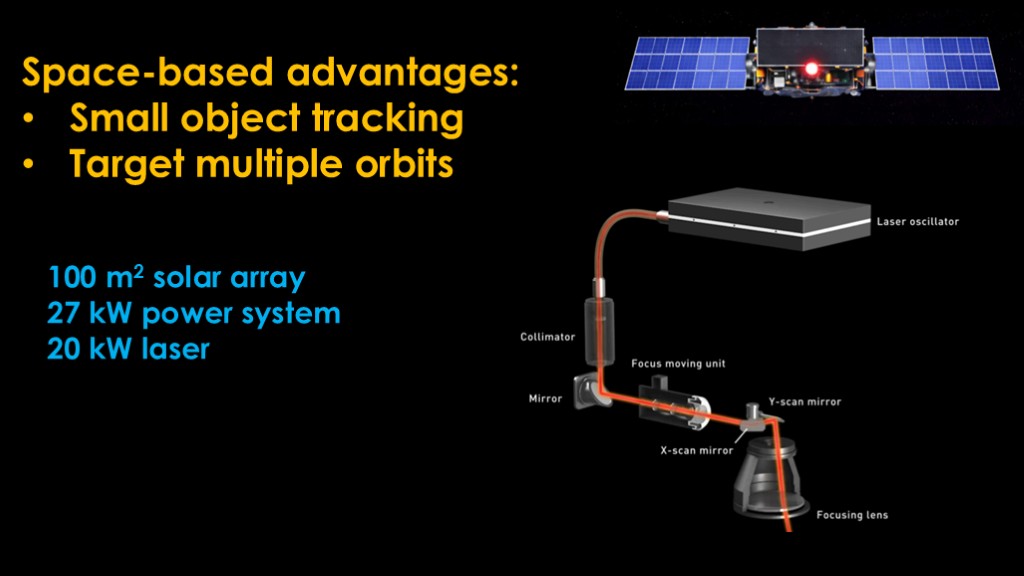
There are some significant advantages to space based systems.
You can track small objects because you are very close to them. That not only means objects that are 1 cm of size, it means objects that are smaller than that.
You can put multiple satellites in different orbits based upon where you think the need is.
The delft design uses a 100 square meter solar array. That's the same area as the Starlink V2 satellites. The array will bring in 27 kilowatts of power and 20 kilowatts will be allocated to the laser.
20 kilowatt lasers are established technology though they would need to be adapted for use in the satellite. You'll need a laser system that can change the size of the laser beam and scan it at appropriate rates to track the object.
https://conference.sdo.esoc.esa.int/proceedings/sdc8/paper/43/SDC8-paper43.pdf
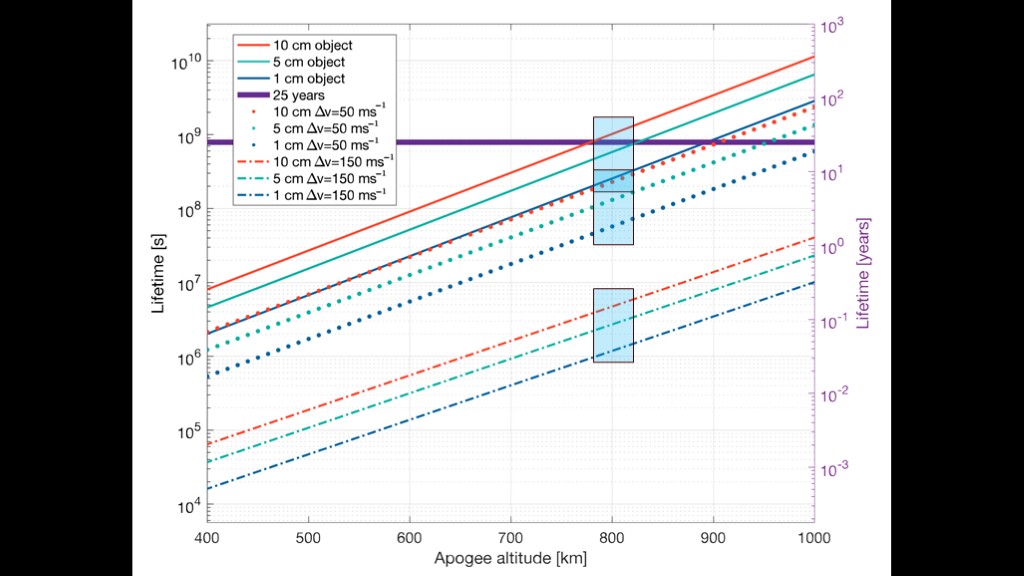
This is a busy chart that shows the effect of specific amounts of delta v on the orbital lifetime of objects in different orbits.
If we look at the data for objects in 800 kilometer orbits - like many of the objects from the Chinese ASAT test and the Iridium 33 and cosmos 2251 collision - we see that the 10 cm objects will likely be in orbit for 30 years, the 5 cm objects for 20 years, and the 1 cm objects for 10 years.
If you can take 50 meters per second off those objects, those numbers go down to 8, 5, and 2 years.
If you can take 150 meters per second off them, those numbers go to 8, 5, and 2 weeks.
What sort of performance can we get from this system?
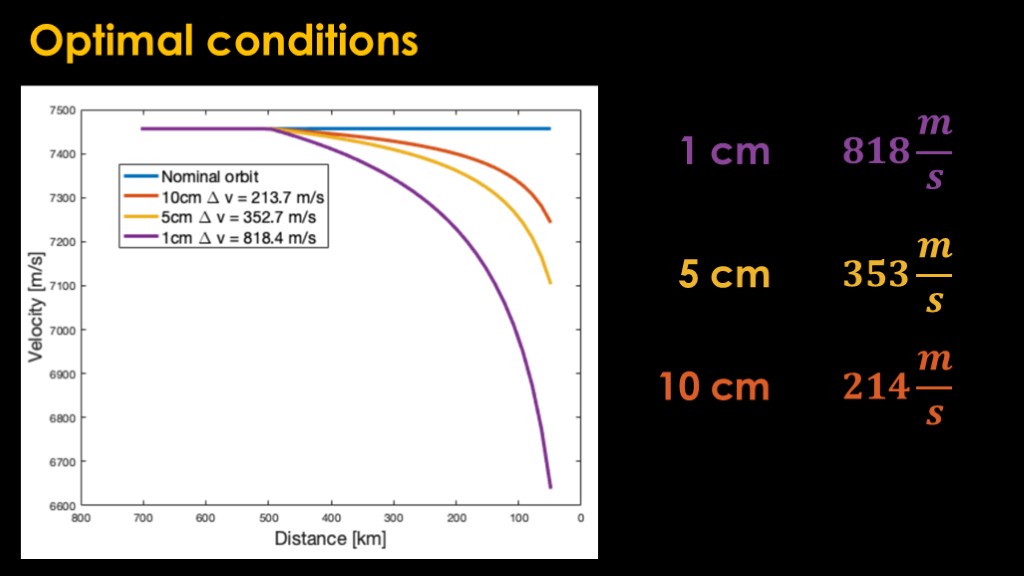
This chart shows the performance of the system under optimal conditions, where the debris object is coming directly at the satellite.
On a 1 centimeter object, it can change the velocity by 818 meters per second, for 5 cm it's 353 meters per second, and for 10 cm it's 214 meters per second.
Those numbers look great - from an 800 kilometer orbit everything deorbits in weeks.
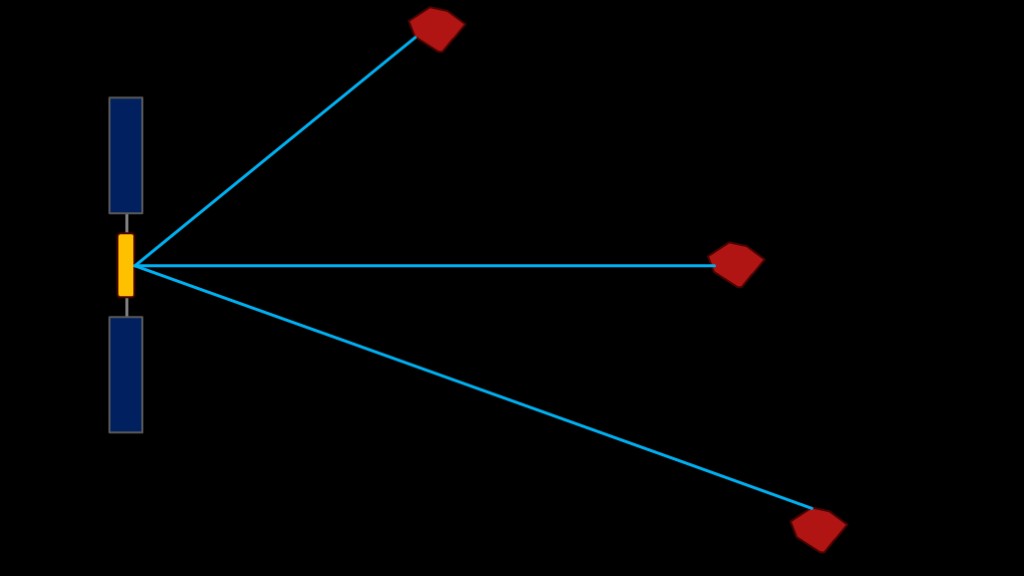
Those numbers assume that the laser hits the object head on, and that is not the common case.
In reality, the objects are going to be in higher or lower orbits and not moving towards the satellite. That reduces the performance quite a lot
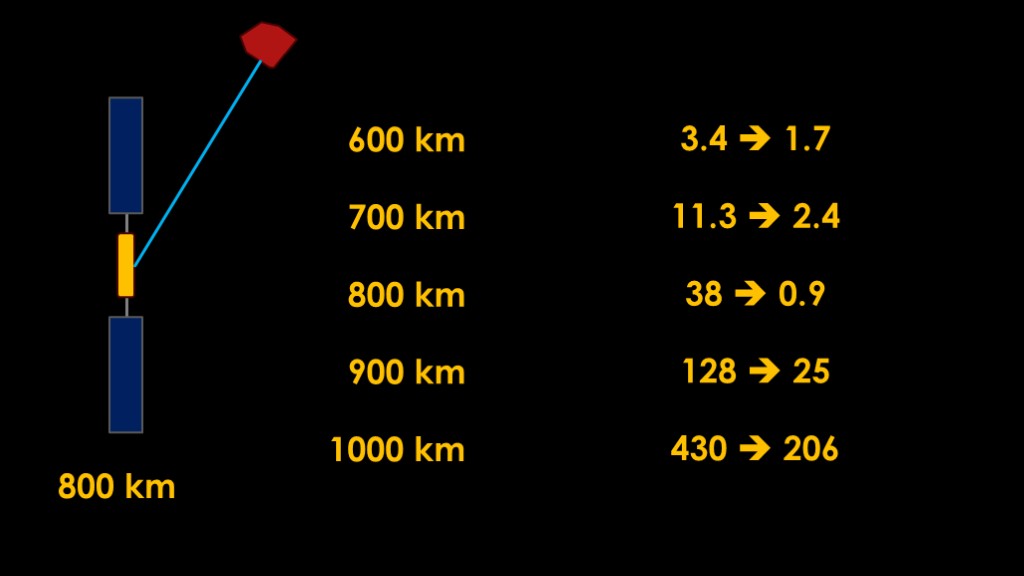
If we look at a worst-case scenario - where the object is 60 degrees off to the side of the path of the satellite, we get the following numbers, all for a 10 cm object and the satellite at 800 kilometers.
For objects at 600 kilometers - 200 kilometers below the satellite - the object lifetime goes from 3.4 to 1.7 years.
At 700 kilometers, it goes from 11.3 to 2.4 years.
At 800 kilometers it goes from 38 to 0.9 years. Being at the same altitude helps a lot.
At 900 kilometers, it goes from 128 years to 25 years.
And at 1000 kilometers, it goes from 430 to 206 years.
The change in lifetime for objects 200 kilometers higher or lower isn't great, but it's still there, and the satellite isn't going anywhere so there might be a second encounter in the future.
Or you could just launch more satellites - if you put one at 600 kilometers, one at 800 kilometers, and one at 1000 kilometers, these numbers look better.
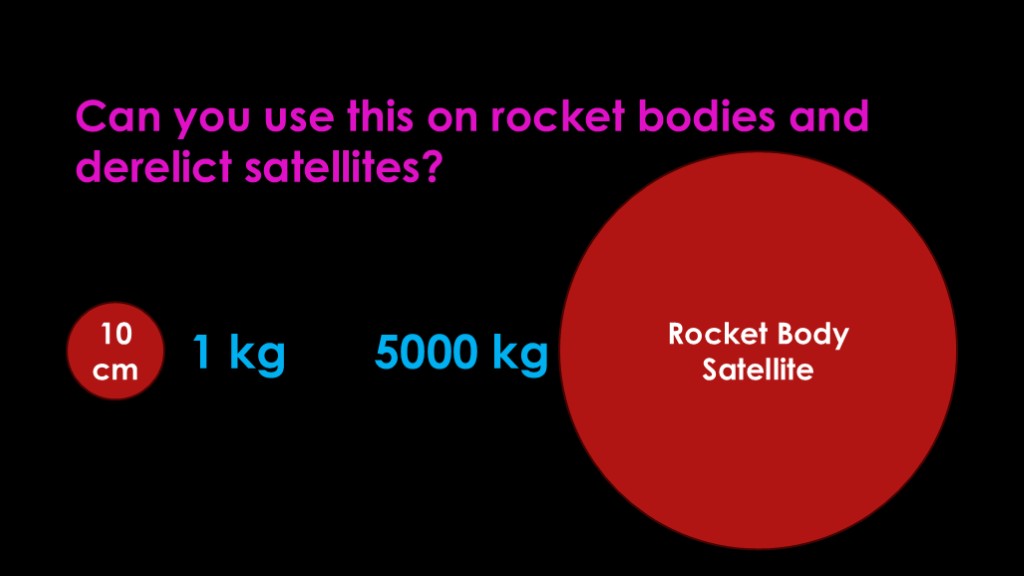
Can you use this on rocket bodies and derelict satellites?
The answer is yes.... But...
A 10 centimeter sphere of aluminum has a mass that is a bit over 1 kilogram.
A rocket body or satellite might have a mass of 5000 kilograms.
That means you'd need to hit the derelict 5000 times to get the same effect as you would hitting the 10 cm object once.
You would need a much bigger laser satellite, a whole lot of satellites, or a lot more time.
Where does this leave us with deorbiting approaches?
Go and get it can work but getting between targets with a single vehicle is very difficult. I think it would work better with launching a bunch of single use tugs to a convenient orbit and letting them do their work.
Of the go and get it technologies, I like the ion beam shepherding the most, because it's essentially built out of existing parts. Any of these approaches will require some talented software to be able to figure out how to apply thrust and adapt to the way the object behaves.
There are significant legal challenges working on any object that is intact. Technically, the same rules apply to any debris from that object, but it seems unlikely anybody is going to care.
For launch it and they will come, laser ablation is the only one that makes sense to me. It will need good software and good pointing hardware, but a single satellite can do a lot in a single mission and it can address a wide range of object sizes, including the 1-10 cm size that isn't handled by other approaches.
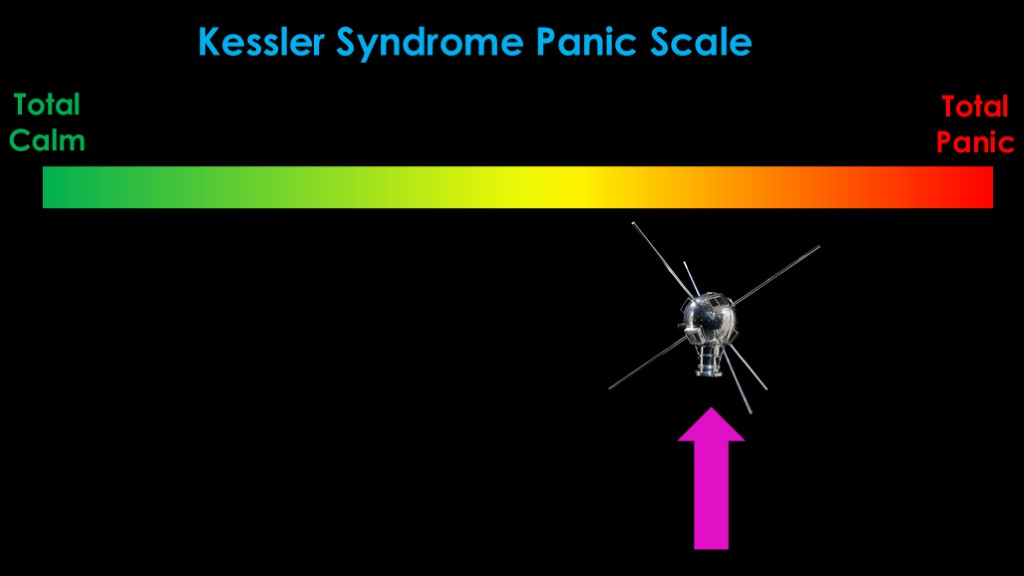
Where does that leave me on the Kessler syndrome panic scale?
It's going to move me a little bit to the left. Assuming you can figure out the legal environment, there are approaches that look workable.
And that's all for part 5.
There will be a part 6 but I promise it's the last one.

That's all for this video.
Today's song is Free Fallin' off of Tom Petty's 1989 quintuple platinum solo album, Full Moon Fever.
I guess that I should explain that "platinum" means 1 million albums sold in the US.
https://www.youtube.com/watch?v=1lWJXDG2i0A